What Is Masa? The Ancient Corn Dough Behind Authentic Mexican Street Food
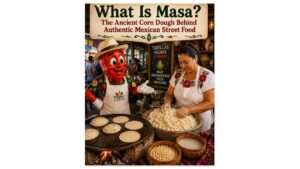
Before Mexico had tacos, tamales, gorditas, sopes, tlacoyos, huaraches, or tlayudas, it had masa—and that’s where the real story begins.
Masa is the soft corn dough created from nixtamalized maize, but calling it “corn dough” barely explains what makes it extraordinary. Mexican cooks can press it thin for tortillas, shape it thick for sopes, stuff it for gorditas and tlacoyos, stretch it into huaraches, or wrap it around fillings for tamales. One ancient foundation somehow becomes an entire street-food universe.
If you’ve ever wondered why authentic Mexican corn tortillas taste different—or how so many completely different dishes can begin with the same handful of corn—masa is the answer.
Stand beside a busy comal in a Mexican market and watch the hands instead of the finished food.
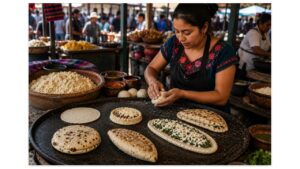
A cook reaches into a container of fresh masa, tears away a portion, rolls it quickly between her palms, and places it beneath the tortilla press. A moment later, what had been an unremarkable ball of pale dough is a thin disk headed for the hot comal. Beside her, another cook handles nearly the same dough differently, leaving it thicker before pinching up the edges for a sope. Somewhere farther down the market aisle, masa is being shaped around beans for tlacoyos, stretched into long huaraches, or spread around seasoned fillings before being wrapped in corn husks for tamales.
At first glance, these foods don’t appear to have much in common. A delicate tortilla seems worlds away from a thick gordita. A crisp-edged sope doesn’t resemble a steamed tamal, and an enormous Oaxacan tlayuda hardly looks related to a stuffed Mexico City tlacoyo.
Yet underneath all of them is one of the great foundations of Mexican cooking.
Masa.
Masa is the dough traditionally produced by grinding corn that has undergone nixtamalization, an ancient process that transforms dried maize into something far more useful, flavorful, and versatile. For thousands of years, Indigenous communities across Mesoamerica have used this transformed corn to create foods that could be pressed, shaped, stuffed, wrapped, steamed, toasted, and cooked directly against intense heat.
Understanding masa changes the way you understand Mexican food because suddenly dozens of dishes stop looking like unrelated specialties. You begin to recognize a shared culinary language beneath them. The tortilla beneath a taco, the thick base of a sope, the stuffed center of a tlacoyo, the triangular form of a corunda, and the masa surrounding the filling of a tamal are different expressions of the same ancient idea.
Our Mexican Tortillas, Masa & Breads Explained: The Complete Guide to How Mexican Street Food Is Built explores that larger architecture—how corn, wheat, masa, tortillas, breads, comales, and regional traditions form the foundations upon which Mexican street food is built. Masa sits at the center of the corn side of that story.
But there’s an important distinction to make immediately.
Masa isn’t simply corn that has been ground and mixed with water.
Traditional masa begins with nixtamalization, in which dried corn is cooked and soaked in an alkaline solution before being rinsed and ground. The process changes the corn physically and chemically, creating the distinctive aroma, texture, flavor, and working properties that make fresh masa possible.
Once you understand that transformation, the Mexican street-food landscape starts looking different.
You stop seeing only dishes.
You start seeing what they’re built from.
🌽 Masa Quick Guide
What is masa?
Masa is a dough traditionally made from corn that has been nixtamalized and ground. It forms the foundation of tortillas, tamales, gorditas, sopes, tlacoyos, huaraches, memelas, and many other Mexican foods.
Is masa the same thing as cornmeal?
No. Traditional masa begins with nixtamalized corn. Ordinary cornmeal is generally produced by grinding dried corn without first putting it through the same traditional alkaline process.
Is masa the same as masa harina?
No. Fresh masa is moist, prepared corn dough. Masa harina is made from nixtamalized corn that has been dried and ground so it can later be rehydrated to produce dough.
What is nixtamalization?
Nixtamalization is the ancient process of cooking and soaking dried corn in an alkaline solution, traditionally using lime. It changes the corn’s texture, flavor, chemistry, and nutritional properties while preparing it to be ground into masa.
What Mexican foods are made from masa?
Corn tortillas, tamales, sopes, gorditas, tlacoyos, memelas, huaraches, picadas, tlayudas, corundas, and many other regional specialties begin with masa or a closely related corn preparation.
Why is masa so important to Mexican cuisine?
Masa connects thousands of years of Indigenous corn traditions with everyday Mexican cooking today. By changing its thickness, shape, filling, cooking method, and regional preparation, Mexican cooks turn the same fundamental dough into remarkably different foods.
🌽 Masa Is More Than Corn Dough
Calling masa “corn dough” isn’t wrong. It’s just incomplete.
The difference becomes obvious when you stand near a tortillería or market stall working with fresh masa. Before the dough even reaches the comal, it has a character that ordinary ground corn mixed with water does not. It feels supple beneath experienced hands and holds together when pressed. Once it meets the hot surface, its aroma changes again, filling the air with the warm, toasted smell associated with fresh tortillas.
That behavior begins long before the dough is shaped.
Maize has been cultivated in Mexico for thousands of years, and Indigenous peoples developed varieties adapted to dramatically different landscapes, climates, colors, flavors, and culinary purposes. Corn became essential not simply because it could be grown, dried, transported, and stored, but because generations of cooks learned how to transform it into foods far more versatile than the kernel itself.
Nixtamalization is central to that transformation.
During the process, dried corn is cooked and soaked in an alkaline solution. Traditionally, calcium hydroxide—commonly called cal or food-grade lime—is used, although alkaline ash has also played a role in some traditions. As the kernels cook and rest, their outer hulls loosen and their texture changes. More importantly, transformations occur that affect the corn’s flavor, nutritional availability, grinding properties, and ability to become cohesive dough.
After the corn has rested, it is rinsed and ground. Traditionally this work could be done on a stone metate; today mills perform much of the grinding in communities where fresh masa remains part of daily life. What emerges isn’t dry corn flour.
It is fresh masa.
Soft, fragrant, pliable masa can then move in dozens of culinary directions depending on who is handling it and where in Mexico you happen to be standing. Press it thin and it can become a tortilla. Keep it thick and give it raised edges and you’re approaching a sope or picada. Shape it around a filling and it can become a gordita or tlacoyo. Prepare and season it differently, surround a filling, wrap it in a husk or leaf, and it enters the enormous family of Mexican tamales.
The ingredient is recognizable from one preparation to the next, but its expression can change completely.
That’s the real significance of masa. It isn’t important because Mexico created one famous food from it. It’s important because Indigenous cooks developed a way of transforming maize that eventually supported an extraordinary number of regional foods, many of which are still being made and eaten every day.
A tortilla fresh from the comal is one expression of masa.
It is nowhere near the only one.
MASA ISN’T SIMPLY DOUGH MADE FROM CORN—IT’S THE TRANSFORMATION THAT ALLOWS CORN TO BECOME AN ENTIRE FAMILY OF MEXICAN FOODS.
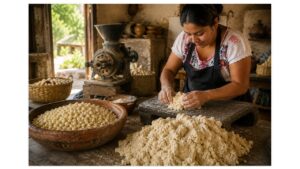
🪨 From Maize to Masa: An Ancient Mesoamerican Breakthrough
Long before the smell of tortillas drifted through modern mercados and taquerías, maize was shaping life across Mesoamerica.
Its importance went far beyond what appeared on the plate. Corn could be dried and stored, making it valuable between harvests and during periods when fresh food was less abundant. Different varieties could be cultivated for different environments and uses. Over generations, maize became intertwined with agriculture, trade, community, belief, and everyday life so deeply that understanding the history of Mexican food without understanding corn is almost impossible.
Yet the remarkable part of the story isn’t simply that ancient peoples grew maize.
They learned how to change it.
At some point deep in Mesoamerican history, Indigenous communities discovered that cooking dried corn with an alkaline substance fundamentally altered the grain. We don’t need to imagine that the first cooks understood the chemistry in modern scientific terms. They could see and feel what happened. The treated kernels softened. Their skins loosened. Grinding became easier. The resulting material behaved differently beneath the hands.
Most importantly for the future of Mexican cooking, the transformed corn could become a cohesive dough.
That discovery created possibilities.
Instead of relying only on whole, roasted, boiled, or conventionally ground corn, cooks now had a material that could be pressed into thin rounds, shaped into thicker cakes, wrapped around fillings, steamed inside leaves and husks, or cooked directly against a heated surface. What began as agricultural knowledge became food technology, and that food technology became tradition.
The process we now call nixtamalization deserves careful attention because the transformation happening inside the kernel is what makes masa possible. Here, however, the most important thing to understand is what that process made possible.
It made masa possible.
And once communities had masa, geography and culture could begin doing the rest.
Travel through Mexico today and you can still see the consequences of that ancient breakthrough. In and around Mexico City, thick masa becomes stuffed tlacoyos and long huaraches cooked on broad comales. In Oaxaca, cooks work masa into memelas and the large tortillas associated with tlayudas. In Veracruz, small thick rounds are pinched at the edges to become picadas capable of holding salsa, cheese, and onion. In Michoacán, masa takes on an entirely different architecture in corundas, the distinctive triangular tamales associated with Purépecha culinary tradition.
These aren’t simply different names for the same food.
Each reflects decisions made over generations: how finely the corn should be ground, how wet or firm the masa should feel, how thick it should be shaped, whether it should be filled, what surface should cook it, how long it should remain over heat, and what local ingredients should accompany it.
That’s why masa is such a useful doorway into regional Mexican cuisine. The foundation may be shared, but the food tells you where you are.
 🌶️ Professor Pepper Says…
When you start recognizing masa instead of memorizing individual dishes, Mexican street food becomes much easier to understand. A tortilla, sope, tlacoyo, huarache, memela, and tamal may look completely different, but each shows what generations of cooks learned to do with transformed corn.
The ancient innovation gave cooks a foundation.
Mexico’s regions turned that foundation into a culinary language.
NIXTAMALIZATION CREATED THE POSSIBILITY; GENERATIONS OF MEXICAN COOKS TURNED MASA INTO THOUSANDS OF YEARS OF LIVING FOOD TRADITION.
🫓 How One Masa Becomes Tortillas, Sopes, Gorditas, Tlacoyos & More
Return to the comal and watch closely, because this is where the idea becomes visible.
A tortilla maker pulls off a small piece of masa and rolls it between her palms. The ball disappears beneath the press, the handle comes down, and seconds later a thin round is lifted carefully onto the hot surface. Steam begins building inside as it cooks. With the right masa, heat, thickness, and technique, the tortilla may eventually inflate, separating into delicate layers before settling again.
Now imagine the cook starting with almost the same ball of masa but deciding not to press it quite so thin.
Suddenly there is enough thickness to shape.
For a sope, that extra masa creates a substantial base that can be cooked and then pinched around its perimeter while still warm, forming a shallow border capable of holding beans, meat, salsa, crema, cheese, and vegetables. In Sopes Explained: Thick Corn Cakes Loaded with Street Food Flavor, that architecture is part of what distinguishes the dish: the masa isn’t merely underneath the toppings. Its thickness and texture are part of every bite.
A gordita asks something different from the dough. Rather than functioning primarily as a topped platform, thicker masa can be cooked and opened or formed to accommodate fillings, creating the stuffed corn pockets explored in Gorditas Explained: Mexico’s Stuffed Corn Pockets Deserve More Love. The ratio changes. There is more masa in every bite, and its relationship with the filling becomes fundamentally different from that of a thin taco tortilla.
Then there is the tlacoyo.
At markets and street stands around central Mexico, an experienced cook can shape masa into an elongated oval around fillings such as beans or other traditional ingredients, flattening it by hand before transferring it to the comal. The result explored in Tlacoyos Explained: Mexico City’s Ancient Stuffed Corn Street Food is thicker and more substantial than a tortilla, with the filling integrated into the masa rather than simply placed on top of it.
Huaraches stretch the idea farther—literally. Their long oval shape resembles the sandal that gave them their name, creating a broad masa surface capable of supporting beans, meats, salsa, cheese, vegetables, and other toppings. Yet even with all that food above it, the foundation remains recognizable as the same family of nixtamalized corn dough.
Move south toward Oaxaca and the transformations continue. Memelas are shaped thick enough for the masa itself to remain central to the eating experience, often meeting asiento, beans, salsa, and cheese on the comal. Tlayudas push the tortilla in another direction altogether, beginning with a much larger format whose preparation creates a texture and eating experience dramatically different from the soft tortilla beneath a small street taco.
In Veracruz, picadas demonstrate how even a small change in shaping can change the purpose of the food. Their pinched edges aren’t decorative. They help contain salsa and toppings, turning a thick piece of masa into a small edible plate.
And masa doesn’t have to meet a comal at all.
Tamales show what happens when cooks take corn dough away from direct dry heat and move it into steam. Masa is prepared around or alongside fillings, wrapped, and cooked until its texture becomes tender and cohesive. In Michoacán, corundas demonstrate how dramatically that concept can change again through shape, wrapping, regional ingredients, and Purépecha tradition.
Once you start seeing these relationships, the enormous diversity of Mexican street food becomes less confusing, not more.
You realize that Mexican cooks haven’t spent centuries inventing hundreds of unrelated corn dishes.
They have spent centuries asking a much more interesting question:
What else can masa become?
Every region seems to have found its own answer.
THE GENIUS OF MASA ISN’T THAT IT MAKES ONE GREAT FOOD—IT’S THAT MEXICO HAS SPENT GENERATIONS DISCOVERING HOW MANY GREAT FOODS ONE DOUGH CAN BECOME.
🌽 Fresh Masa vs. Masa Harina: They’re Related, but They Aren’t the Same Thing
Walk into a neighborhood tortillería while production is underway and fresh masa doesn’t look particularly dramatic. There may be a large pale mound of it waiting beside the tortilla machine, portions moving steadily toward the press, or workers handling heavy quantities of dough with the efficiency that comes from repeating the same process thousands of times.
But lean closer and the differences begin to reveal themselves.
Fresh masa has moisture, weight, aroma, and life to it. Depending on the corn and preparation, its color can range from creamy white and warm yellow to shades of blue or purple. Pinch off a piece and it should feel cohesive rather than sandy, pliable enough to shape without crumbling yet not so wet that it sticks hopelessly to your hands.
Most importantly, it smells like corn—but not like an opened bag of cornmeal.
There is a distinctive aroma created by nixtamalization and grinding: earthy, warm, slightly mineral, unmistakably maize. When that masa hits a hot comal, the aroma intensifies as moisture escapes and the surface begins to toast. Anyone who has stood near a working tortillería knows that smell can travel well beyond the doorway.
Fresh masa is traditionally produced from nixtamalized corn that has been ground while still moist. In places where fresh masa is readily available, cooks can buy it from a tortillería or molino and bring it home ready to shape into tortillas, tamales, gorditas, sopes, or whatever the meal requires.
But fresh masa has an obvious limitation.
It doesn’t travel particularly well.
It contains moisture, is perishable, and is at its best when relatively fresh. For generations of cooks living near molinos and tortillerías, that wasn’t necessarily a problem. Fresh masa could be part of the daily food infrastructure. For someone living hundreds or thousands of miles from a Mexican molino, however, getting good fresh masa can be much more difficult.
That’s where masa harina changed the equation.
Masa harina begins with the same essential idea—corn undergoes nixtamalization—but instead of remaining as fresh moist dough, the prepared corn is dried and milled into flour. Add water back to that flour and it can once again form a workable masa.
That convenience is enormously important. Masa harina made it possible for home cooks to prepare corn tortillas and other masa foods without starting with dried whole corn, performing nixtamalization themselves, and grinding the resulting nixtamal.
But convenience shouldn’t erase the distinction.
Fresh masa and rehydrated masa harina can both produce excellent food, but they are not identical experiences. Fresh masa from a skilled molino can preserve characteristics of the particular corn, grind, moisture level, and local preparation in ways that dried flour may not reproduce exactly. Masa harina, meanwhile, offers consistency, accessibility, and practicality that make traditional-style corn cooking possible almost anywhere.
Neither needs to be treated as the villain.
The better question is what you’re trying to make, what ingredients you can realistically obtain, and how much control you want over the process.
The simplest distinction is the one worth remembering:
Fresh masa is already dough.
Masa harina is the dried ingredient you rehydrate to make it.
Understanding that difference eliminates one of the most common points of confusion in Mexican corn cooking.
FRESH MASA AND MASA HARINA SHARE THE SAME NIXTAMALIZED CORN FAMILY, BUT ONE ARRIVES AS LIVING DOUGH WHILE THE OTHER GIVES YOU A PRACTICAL WAY TO REBUILD IT.
👃 What Good Masa Should Smell, Feel & Taste Like
Recipes tend to describe masa with measurements.
Experienced cooks often describe it with their hands.
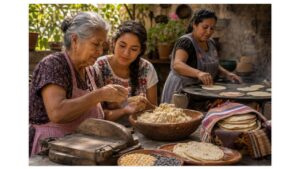
Watch someone who has made tortillas for decades and you’ll notice how little hesitation there is. Fingers press into the dough. A small piece is rolled between the palms. The surface is examined almost unconsciously. If the masa cracks when flattened, it may need more moisture. If it clings aggressively to the hands, something needs adjusting in the other direction.
The cook isn’t following a stopwatch.
She’s reading the dough.
That sensory knowledge is difficult to capture in a recipe because corn isn’t perfectly uniform. Different maize varieties behave differently. Fresh masa from one molino may contain a different amount of moisture than masa from another. Even masa harina can require slight adjustments depending on the brand, grind, humidity, and food being prepared.
Good tortilla masa should generally feel soft and cohesive, with enough moisture to flatten without developing deep cracks around the edges. It shouldn’t crumble when handled, but it also shouldn’t behave like paste. When pressed between plastic or another traditional barrier, the tortilla should release cleanly enough to move onto the comal without disintegrating in your hands.
For thicker foods, the ideal texture may change.
A sope needs enough structure to survive being cooked and then pinched around its edge. A gordita needs to maintain its shape and, depending on the style, accommodate a filling or open cleanly after cooking. Tlacoyos must hold together around their filling while being shaped into their characteristic elongated form. Tamal masa is prepared differently again because its destination is steam rather than direct contact with a comal.
There isn’t one universal “perfect masa.”
There is masa appropriate for what the cook intends to make.
Flavor tells another part of the story. Fresh masa should taste distinctly of corn, but the best examples have greater depth than simple sweetness. Nixtamalization contributes characteristic aromas and flavors, while the maize itself can bring differences that become particularly noticeable when tortillas are eaten fresh and relatively unadorned.
That’s one reason a freshly made tortilla can be so revealing.
Cover mediocre tortillas beneath meat, cheese, salsa, crema, onions, and chile and you can disguise a lot. Eat a warm tortilla directly from the comal with almost nothing on it and there is nowhere for the corn to hide.
In many Mexican kitchens, that isn’t a problem.
The tortilla is good enough to eat by itself.
🌶️ Professor Pepper Says…
Recipes can tell you how much water to add, but your hands eventually tell you whether the masa is right. Good masa should respond to shaping without crumbling or sticking excessively, and the ideal texture changes depending on whether you’re making a thin tortilla, thick sope, stuffed gordita, or steamed tamal.
GREAT MASA ISN’T DEFINED BY ONE PERFECT RECIPE—IT’S DEFINED BY WHETHER THE DOUGH BEHAVES THE WAY THE FOOD NEEDS IT TO.
🔥 Masa Meets the Comal: Where Dough Becomes Food
Fresh masa has potential.
The comal gives that potential flavor.
Across Mexico, the comal has served as one of the essential cooking surfaces for corn foods for generations. Traditional versions could be made from clay; today metal comales are common in homes, markets, tortillerías, and street-food stalls. The materials may differ, but the principle remains wonderfully simple: a broad, hot surface provides direct heat without requiring a pot full of oil or water.
Place a freshly pressed tortilla onto that surface and the transformation begins almost immediately.
The moist dough starts losing water. The bottom surface sets against the heat while toasted aromas develop. The tortilla is turned, allowing the other side to cook, and under the right conditions something particularly satisfying may happen: it begins to inflate.
That puff isn’t merely theatrical.
As steam develops inside the tortilla, its layers separate and the center can balloon upward before settling again. The cook watches the color, texture, edges, and behavior of the tortilla rather than simply waiting for a timer to announce that it’s done.
A few seconds matter.
Too little heat and the tortilla can dry before cooking properly. Too much time and softness gives way to brittleness. Correct heat allows the surface to toast while enough moisture remains inside for the tortilla to stay tender and flexible.
The comal also reveals just how differently masa behaves when its shape changes.
A thin tortilla cooks quickly because heat has very little dough to penetrate. A thick sope needs more time for the center to cook. A stuffed tlacoyo asks the cook to manage both the exterior masa and the filling sealed within it. A huarache creates a larger surface with its own challenges of thickness and even cooking.
The cooking surface may be the same.
The cook’s judgment changes with the food.
That interaction between masa, thickness, moisture, and heat is why the comal deserves more attention than it usually receives. It isn’t simply a Mexican version of a frying pan. It is part of the architecture of the food, influencing moisture, texture, browning, aroma, and ultimately the way the finished masa tastes.
Our How a Comal Gives Mexican Street Food Its Signature Flavor goes much deeper into that relationship. But if you want to understand masa, remember that making the dough is only half the lesson.
You also have to understand what happens when that dough meets heat.
MASA GIVES MEXICAN CORN FOOD ITS FOUNDATION; THE COMAL TURNS THAT FOUNDATION INTO TEXTURE, AROMA, AND FLAVOR.
🗺️ Masa Changes as You Travel Across Mexico
There is a temptation when learning Mexican food to imagine masa as a standardized ingredient: one corn dough used throughout the country, changing only according to the shape a cook gives it.
Travel makes that idea difficult to maintain.
Mexico’s relationship with maize is intensely regional. Different communities have historically cultivated different varieties of corn, worked with different grinding traditions, adjusted masa for different dishes, and paired it with ingredients shaped by local agriculture and culture. Even when two foods begin with nixtamalized maize, the experience of eating them can be dramatically different.
In central Mexico, especially around Mexico City and neighboring states, the comal becomes a stage for an extraordinary variety of masa foods. Thin tortillas share space with tlacoyos, gorditas, sopes, and huaraches. A market cook may work from a single supply of masa while changing thickness, filling, shape, and cooking time according to each customer’s order.
Travel south into Oaxaca and corn takes on another personality. Masa appears in memelas, tortillas, tamales, and the enormous tortilla associated with Tlayudas Explained: Oaxaca’s Giant Street Food Masterpiece. The region’s extraordinary maize diversity and deeply rooted Indigenous food traditions make corn more than a neutral carrier for toppings; the grain itself remains part of the identity of the meal.
Move east toward Veracruz and you’ll find another expression in Picadas Explained: Veracruz’s Handmade Corn Cakes Loaded with Authentic Street Food Flavor. Here, thick hand-shaped masa bases are pinched around the edges and finished with salsa and other toppings, creating a food whose architecture makes sense the moment you watch it being assembled.
Michoacán takes masa somewhere else again. Tamal traditions include Corundas Explained: Michoacán’s Triangular Tamales with Ancient Purépecha Roots, where shape, wrapping, preparation, and Indigenous history produce something immediately recognizable as belonging to a particular regional tradition.
Then head north and the larger Mexican grain story changes dramatically.
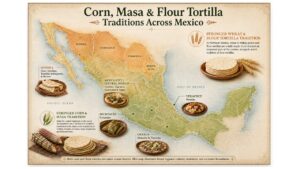
Corn doesn’t disappear, but wheat becomes much more prominent. Sonora, Chihuahua, Coahuila, Nuevo León, and other northern areas developed strong flour-tortilla traditions alongside their corn foods. The oversized, exceptionally thin tortillas of Sonora demonstrate why Mexican tortilla culture can’t be reduced to the idea that “authentic means corn.” Our Flour Tortillas Explained: Why Northern Mexico Chose Wheat Over Corn explores why geography, agriculture, ranching, and history pushed the north toward a different tortilla tradition.
That contrast actually makes masa more interesting.
It reminds us that Mexican food isn’t a national formula repeated from one border to the other. It’s a conversation between ingredients and place. Corn dominates one landscape. Wheat becomes important in another. One community stretches masa thin; another keeps it thick. One wraps it in a corn husk; another in a leaf. One stuffs the dough before it reaches the comal; another piles ingredients on afterward.
The foundation matters.
So does where you are standing.
THERE IS NO SINGLE MEXICAN MASA TRADITION—THERE ARE GENERATIONS OF REGIONAL TRADITIONS BUILT FROM CORN, PLACE, AND THE HANDS THAT BRING THEM TOGETHER.
🛒 Buying Fresh Masa: What to Look for at a Tortillería or Molino
If you’re lucky enough to live near a tortillería or Mexican molino that sells fresh masa, buying it can feel almost suspiciously easy.
You walk in, ask for masa, and leave carrying a bag of pale dough that has already undergone the most labor-intensive part of the process. The corn has been nixtamalized, rinsed, ground, and transformed into something ready to become dinner.
But there’s an important question to ask before you leave:
What are you making?
Not all prepared masa is intended to do the same job.
If you’re making corn tortillas, sopes, gorditas, tlacoyos, or similar comal-cooked foods, you generally want fresh masa prepared for tortillas. It should feel moist and cohesive without being sticky, and it should smell distinctly of freshly processed corn. Depending on the molino, the corn variety, grind, and hydration may differ from what you’d find somewhere else.
If you’re making tamales, however, simply asking for “masa” may not tell the whole story.
Many Mexican markets and tortillerías distinguish between masa intended for tortillas and masa para tamales. Tamal masa may be ground or prepared differently, and cooks commonly add ingredients such as fat, broth, salt, seasonings, and sometimes leavening depending on the recipe and regional tradition. Some shops also sell masa preparada, meaning much of that preparation has already been done.
That’s worth understanding because tortilla masa and finished tamal masa are trying to accomplish different things.
A tortilla needs to survive pressing, transfer cleanly to the comal, cook relatively quickly, and remain flexible enough to fold around food. Masa destined for tamales must perform during a longer steaming process and produce the texture appropriate to that particular tamal tradition.
And there isn’t only one correct tamal texture.
Some are expected to be relatively light and tender. Others are denser. Regional traditions, wrapping materials, fillings, fats, hydration, and preparation techniques all influence the final result.
For the person standing at the counter of a tortillería or molino, however, the practical lesson is much simpler: tell the person selling the masa what you plan to make.
Tortillas? Tamales? Gorditas? Sopes?
An experienced masa maker will understand why the answer matters.
That small conversation can teach you more than the label on a package ever will.
THE BEST MASA ISN’T JUST FRESH—IT’S MASA PREPARED FOR THE FOOD YOU’RE ACTUALLY TRYING TO MAKE.
🏠 Can You Make Authentic Masa at Home?
Yes.
But there are two very different ways to answer that question.
The first is the ancient route: start with dried field corn, nixtamalize it, rinse it, grind it while moist, and turn the resulting dough into tortillas or another masa-based food.
The second is the route most home cooks outside Mexico are far more likely to use: start with masa harina, add water, and rebuild the dough that drying made shelf-stable.
Both can put homemade tortillas on your table.
They are not the same process.
Making fresh masa from whole corn gives you control from the beginning. You can choose the maize, control the nixtamalization, adjust the washing and grinding, and experience the transformation we’ve spent this article discussing rather than beginning after most of that work has already been completed.
It’s also considerably more involved.
Nixtamalization requires the appropriate corn and food-grade alkaline ingredient, time for cooking and soaking, rinsing, and—most challenging for many home cooks—a way to grind the wet nixtamal finely enough to produce good masa. A standard kitchen appliance isn’t necessarily equivalent to the equipment used by a molino.
That shouldn’t discourage curious cooks from learning the process. Quite the opposite. Making masa from whole corn at least once can fundamentally change how you understand tortillas because the relationship between kernel and finished food becomes tangible.
You smell the corn change. You feel the nixtamal between your fingers. You discover what properly ground fresh masa feels like.
And when the first tortilla finally reaches the comal, you’re no longer looking at an anonymous disk of dough. You know exactly what happened to get it there.
And when the first tortilla finally reaches the comal, you’re no longer looking at an anonymous disk of dough. You know exactly what happened to get it there.
For everyday cooking, however, good masa harina is extraordinarily useful. It allows someone thousands of miles from the nearest Mexican molino to mix dough, press a tortilla, and cook it moments later. That’s not something to dismiss simply because a more labor-intensive method exists.
Authenticity isn’t measured by how inconvenient you can make dinner.
What matters is understanding what the traditional process is, respecting where it came from, and knowing what changes when you choose a more convenient route.
If you can get excellent fresh masa, use it.
If you want to experience the entire process, learn to nixtamalize and grind corn.
And if masa harina is what makes homemade tortillas possible in your kitchen, there is absolutely a place for it.
THE BEST WAY TO UNDERSTAND MASA IS TO PUT YOUR HANDS IN THE DOUGH—WHETHER YOU START WITH WHOLE NIXTAMALIZED CORN OR REHYDRATE MASA HARINA AT HOME.
⚠️ Common Masa Mistakes That Ruin Tortillas Before They Reach the Comal
A tortilla can tell you something is wrong before you ever taste it.
Sometimes it tells you before it even reaches the comal.
Press a ball of masa and watch the perimeter. If deep cracks immediately spread around the edges, the dough may be too dry. Try lifting it and the tortilla may split, crumble, or refuse to leave the press in one piece.
Add too much water and the opposite problem appears. Masa begins clinging to fingers and surfaces, becoming frustratingly difficult to transfer without stretching or tearing.
Neither problem is particularly mysterious.
The dough is talking to you.
One of the most common mistakes beginning tortilla makers make is treating the amount of water in a recipe as an immutable law. Masa doesn’t work that way. Different masa harinas absorb water differently, fresh masa arrives with its own moisture level, and even the environment in your kitchen can affect how dough behaves.
Use the recipe as a starting point.
Then use your hands.
Another mistake is ignoring rest. When masa harina is mixed with water, giving the dough a short period to hydrate evenly can improve its consistency. If it feels slightly dry after resting, a little additional water can be worked in rather than forcing a crumbly dough through the tortilla press.
Then there is thickness.
Pressing every tortilla as thin as physically possible isn’t necessarily the goal. The tortilla needs enough structure to move from press to comal and enough substance to suit what you’re serving. Regional tortillas vary considerably, and the enormous paper-thin flour tortillas of Sonora shouldn’t become the mental standard for how a corn tortilla ought to behave.
Heat creates another dividing line between good intentions and good tortillas.
A comal that isn’t hot enough can leave tortillas drying slowly rather than cooking properly. Excessive heat can scorch the exterior before the interior has cooked as intended. Once again, experienced cooks learn to read what is happening rather than blindly obeying a number on a dial.
And finally, even a beautifully cooked tortilla can be ruined after it leaves the heat.
Leave fresh tortillas exposed on a plate and moisture escapes quickly. Stack them and keep them wrapped beneath a clean cloth or inside a tortilla warmer and the retained steam helps keep them soft and pliable.
That final step seems almost trivial.
It isn’t.
A tortilla is still changing after it leaves the comal.
🌶️ Professor Pepper Says…
If your tortilla cracks around the edges when you press it, don’t immediately blame your tortilla-making skills. Your masa may simply be asking for a little more water. Learn to read the dough first—the press and comal can only work with what you give them.
GOOD TORTILLAS BEGIN BEFORE THE COMAL—MOISTURE, REST, THICKNESS, HEAT, AND HANDLING ALL START WITH LEARNING TO READ THE MASA.
🌽 Why Masa Still Matters in Modern Mexican Food
It would be easy to tell the story of masa as ancient history.
That would miss the most interesting part.
The remarkable thing about masa isn’t simply that Indigenous peoples developed nixtamalization thousands of years ago. It’s that the resulting food tradition never became merely historical.
Masa still wakes up early.
Before many customers arrive, tortillerías are already working. Corn has been processed, machines and grinders are running, tortillas begin accumulating in warm stacks, and fresh masa moves outward into homes, restaurants, mercados, and street-food stands.
By breakfast, it may have become a tortilla wrapped around eggs or another morning filling.
By lunchtime, another batch of the same basic foundation may sit beneath salsa on a sope, surround beans inside a tlacoyo, or carry grilled meat as a taco.
By evening, masa foods remain part of the rhythm of markets and street stands, their surfaces taking on toasted spots as they move across crowded comales.
This is ancient food technology operating on a modern schedule.
And that continuity matters.
Mexican cuisine has never been frozen in time. Ingredients arrived from elsewhere. Wheat became deeply important in Northern Mexico. Cooking equipment changed. Industrial tortillerías transformed production. Masa harina made nixtamalized corn dough accessible far beyond communities with local molinos. Migration carried tortilla traditions across borders and oceans.
Yet the basic relationship between maize, nixtamalization, masa, hands, and heat remains recognizable.
That doesn’t mean every tortilla must be handmade to have cultural value, nor does it mean food stops being authentic the moment technology enters the kitchen. Mexican cooks have always adapted tools and ingredients to circumstances.
The deeper continuity is knowledge: knowing how masa should feel, when a tortilla is ready to turn, which consistency works for a tlacoyo and which works for a tamal, how to keep tortillas warm, and—perhaps most fundamentally—knowing that the corn itself matters.
Those small pieces of knowledge accumulate across generations until something as ordinary as a tortilla becomes a record of agriculture, chemistry, geography, technique, and family memory.
Those small pieces of knowledge accumulate across generations until something as ordinary as a tortilla becomes a record of agriculture, chemistry, geography, technique, and family memory.
That’s why masa deserves to be understood as more than an ingredient.
It is simultaneously raw material and technique, ancient innovation and everyday convenience, national symbol and intensely regional food.
You can study it for years.
Or you can stand beside a comal, accept a tortilla while it’s still hot enough to sting your fingertips, and understand quite a lot in one bite.
MASA HAS SURVIVED FOR THOUSANDS OF YEARS NOT BECAUSE MEXICO PRESERVED IT AS HISTORY, BUT BECAUSE GENERATION AFTER GENERATION KEPT MAKING FOOD WITH IT.
🌶️ Recommended Peppers of Key West Products for Masa-Based Mexican Foods
Masa may provide the foundation, but what goes on, inside, and beside it determines where the finished food goes next.
That’s especially true with masa-based street foods. A relatively simple corn tortilla can carry smoky carne asada and sharp salsa. A thick sope can handle beans, meat, crema, cheese, chile, and acidity. Gorditas and tlacoyos bring fillings into the equation, while tamales require sauces that complement rather than overwhelm the corn and filling.
That makes masa less of a flavor-pairing endpoint than a canvas.
Product Pairing Quick Guide
- Carne asada tacos on fresh corn tortillas → Peppers of Key West Habanero Pepper Hot Sauce
- Sopes with beans, meat, crema & cheese → Peppers of Key West Serrano Pepper Hot Sauce
- Gorditas and tlacoyos → Peppers of Key West Cayenne Pepper Hot Sauce
- Tamales and corundas → Peppers of Key West Jalapeno Garlic Hot Sauce
- Tlayudas, huaraches & loaded masa foods → Peppers of Key West Ghost Pepper Hot Sauce
- A table full of tacos, sopes, gorditas & other masa favorites → Peppers of Key West 5 Pack for giving everyone a different way to add heat
🌶️ Best Peppers of Key West Pairings for Masa Lovers
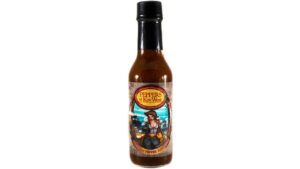
🌶️ Peppers of Key West Habanero Pepper Hot Sauce
Best with: Carne asada tacos on fresh corn tortillas
Fresh corn tortillas and smoky carne asada can handle the bright, assertive heat of Peppers of Key West Habanero Pepper Hot Sauce. Try it with carne asada tacos, grilled beef, charred onions, fresh salsa, and a squeeze of lime.
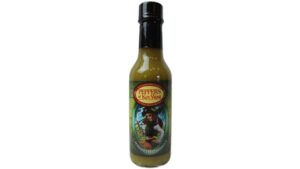
🌶️ Peppers of Key West Serrano Pepper Hot Sauce
Best with: Sopes with beans, meat, crema & cheese
Peppers of Key West Serrano Pepper Hot Sauce brings lively chile heat to richly topped sopes without overwhelming the flavor of the masa. It’s especially good with beans, carne asada, crema, crumbled cheese, and fresh vegetables.
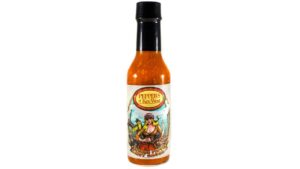
🌶️ Peppers of Key West Cayenne Pepper Hot Sauce
Best with: Gorditas and tlacoyos
The versatile heat of Peppers of Key West Cayenne Pepper Hot Sauce makes it an easy match for stuffed masa foods. Add it to gorditas and tlacoyos filled with beans, cheese, shredded meat, potatoes, or other savory fillings.
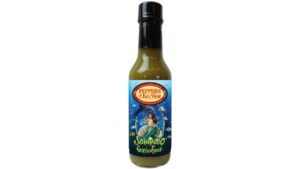
🌶️ Peppers of Key West Jalapeno Garlic Hot Sauce
Best with: Tamales and corundas
Peppers of Key West Jalapeno Garlic Hot Sauce adds savory chile-and-garlic flavor without burying the corn character of steamed masa. Try it with tamales, corundas, shredded chicken, pork, cheese, and roasted vegetables.
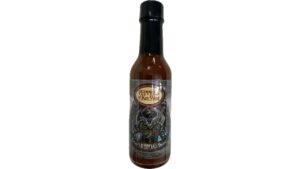
🌶️ Peppers of Key West Ghost Pepper Hot Sauce
Best with: Tlayudas, huaraches & loaded masa foods
Big, loaded masa dishes give Peppers of Key West Ghost Pepper Hot Sauce plenty to work with. A little adds serious heat to tlayudas, huaraches, grilled meats, beans, cheese, avocado, and other substantial toppings.
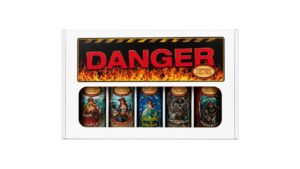
🌶️ Peppers of Key West 5 Pack
Best with: A table full of tacos, sopes, gorditas & other masa favorites
From tacos and sopes to gorditas and huaraches, the Peppers of Key West 5 Pack lets everyone explore different flavors and heat levels with their favorite masa foods.
To Understand Mexican Street Food, Start with the Dough
Return one last time to that market comal.
The cook reaches for another piece of masa.
Now you know how much history is sitting in her hand.
The dough began as maize, part of an agricultural relationship stretching back thousands of years. Nixtamalization transformed the kernel. Grinding transformed the nixtamal. Water, touch, pressure, shape, filling, wrapping, and heat will determine what happens next.
Perhaps this piece becomes a tortilla.
Perhaps a sope.
Perhaps someone folds filling inside it and shapes a gordita. Perhaps it becomes a tlacoyo, huarache, memela, picada, tamal, or one of the countless regional foods that make Mexico’s relationship with corn so extraordinary.
That’s why asking “What is masa?” eventually leads to a much bigger answer than “corn dough.”
- It is a technology.
- It is an ingredient.
- It is a technique.
- It is regional.
- It is ancient.
And every morning somewhere in Mexico, someone puts fresh masa onto a hot surface and makes it new again.
The next time a warm corn tortilla arrives beneath your taco, don’t look only at what’s piled on top.
Taste the foundation.
UNDERSTAND MASA, AND YOU BEGIN TO UNDERSTAND HOW MEXICO BUILT AN ENTIRE CULINARY WORLD FROM CORN.
🌽 Frequently Asked Questions About Masa
Is masa naturally gluten-free?
Traditional corn masa made from maize, water, and food-grade lime is naturally gluten-free. Masa harina made only from nixtamalized corn is generally gluten-free as well, but anyone avoiding gluten for medical reasons should still check packaging and manufacturing information for possible cross-contact. Wheat-based doughs such as flour tortilla dough are a different category entirely.
Is masa raw or already cooked?
Fresh masa occupies an interesting middle ground. The corn has already been cooked and soaked during nixtamalization before being ground, but the resulting masa is normally cooked again after shaping. A tortilla goes onto a hot comal, a tamal cooks through steaming, and foods such as sopes, gorditas, tlacoyos, and huaraches require their own cooking methods.
Can you eat fresh masa without cooking it?
Fresh masa is intended to become a cooked food rather than something eaten directly from the bag or molino. Even though the corn has been heated during nixtamalization, shaping and cooking the masa develops the texture, aroma, structure, and toasted corn flavor associated with finished masa foods.
Can you freeze fresh masa?
Yes. Fresh masa can be frozen when you cannot use it quickly, although texture and handling may change somewhat after thawing. Portioning it before freezing makes it easier to defrost only what you need. Once thawed, check the consistency with your hands and adjust moisture if necessary before shaping.
Why is some masa blue?
Blue masa comes from blue or blue-purple varieties of maize rather than food coloring. Mexico’s maize diversity extends far beyond the familiar yellow and white corn common in American supermarkets, and different varieties can produce masa with distinctive colors, aromas, flavors, and textures.
Is blue corn masa better than white or yellow masa?
Not inherently. “Better” depends on the maize, freshness, nixtamalization, grinding, preparation, and food being made. Color can indicate a different corn variety and bring noticeable characteristics, but excellent masa can be made from white, yellow, blue, red, and other traditional maize varieties.
Is masa the same thing as polenta or cornmeal?
No. All come from corn, but they’re produced and used differently. Traditional Mexican masa begins with nixtamalized maize, while ordinary cornmeal and most polenta do not undergo the same alkaline process before grinding. That difference affects flavor, texture, nutrition, and—critically—how the ground corn behaves when you try to turn it into dough.
Can you make masa with regular corn flour?
Ordinary corn flour isn’t automatically a substitute for masa harina. Masa harina is produced from corn that has first undergone nixtamalization, then been dried and ground. If a recipe calls for masa harina, look for a product specifically intended for making masa rather than assuming any finely ground corn flour will behave the same way.
Can tortilla masa be used to make tamales?
Fresh tortilla masa can serve as a starting point for some tamal preparations, but masa for tamales is generally prepared differently for the job it has to perform. Fat, liquid, seasoning, consistency, and sometimes leavening may be adjusted before the masa is spread, filled, wrapped, and steamed. Regional traditions also differ considerably, so there isn’t one universal formula for tamal masa.
Why does my masa crack when I press a tortilla?
Cracking around the perimeter is often a sign that the masa needs more moisture. Work in a small amount of water, give it time to distribute through the dough, and try pressing another tortilla. You’re looking for edges that remain relatively smooth rather than breaking into deep fissures.
Why won’t my corn tortillas puff?
Moisture, thickness, comal temperature, pressing, and cooking technique can all affect puffing. A tortilla that doesn’t inflate isn’t automatically inedible, but learning to manage the relationship between properly hydrated masa and a sufficiently hot comal greatly improves your chances of developing that characteristic pocket of steam.
What is the difference between a molino and a tortillería?
A molino, in this context, grinds prepared nixtamalized corn into fresh masa. A tortillería specializes in producing and selling tortillas and may work with fresh masa produced on-site or supplied through another operation. In some communities and businesses, the processes exist under the same roof, so the distinction isn’t always visible to the customer.
🌮 Continue Your Mexican Masa Journey
- Start Here: Mexican Tortillas, Masa & Breads Explained: The Complete Guide to How Mexican Street Food Is Built
🌽 Understand the Corn Behind the Masa
- What Is Nixtamalization? The Ancient Process Behind Authentic Mexican Flavor
- Masa Harina Explained: The Nixtamalized Corn Flour Behind Homemade Tortillas
- Masa vs. Masa Harina: What’s the Difference and Which One Do You Need?
- How Corn Becomes Masa: The Story Behind Every Authentic Tortilla
- Mexican Corn Explained: Blue, White, Yellow & Red Maize and How They’re Used
🫓 See What Masa Becomes
- Tamales Explained: The Ancient Mexican Comfort Food That Still Dominates Street Food Culture
- Gorditas Explained: Mexico’s Stuffed Corn Pockets Deserve More Love
- Sopes Explained: Thick Corn Cakes Loaded with Street Food Flavor
- Tlacoyos Explained: Mexico City’s Ancient Stuffed Corn Street Food
- Huaraches Explained: Mexico’s Giant Oval Street Food Loaded with Flavor
- Memelas Explained: Oaxaca’s Thick Corn Street Food Favorite
- Tlayudas Explained: Oaxaca’s Giant Street Food Masterpiece
- Picadas Explained: Veracruz’s Handmade Corn Cakes Loaded with Authentic Street Food Flavor
Explore the Bigger Mexican Food Story
- The Complete Mexican Street Food Guide: Ingredients, Dishes, Regions & Cooking Terms Explained
- Regional Mexican Street Food Guide: Famous Dishes from Every Corner of Mexico
- Mexican Street Food Markets Explained: How to Order Like a Local and Find the Best Food Fast
See More Keywords
fresh corn masa, masa preparada, masa para tortillas, masa para tamales, Mexican tortilla dough, corn tortilla masa, authentic corn tortillas, homemade corn tortillas, nixtamalization, nixtamal, maize, Mexican maize, blue corn masa, white corn masa, yellow corn masa, Mexican corn varieties, molino Mexico, molino de nixtamal, Mexican tortillería, traditional tortilla making, comal cooking, Mexican comal, masa texture, masa hydration, masa cracking, tortilla press, handmade Mexican tortillas, masa foods, gordita masa, sope masa, tlacoyo masa, tamal masa, Mesoamerican corn, Indigenous Mexican corn traditions
