
Poblano Pepper Explained: Flavor, Heat, Uses & Why It’s the Chile Behind Chiles Rellenos
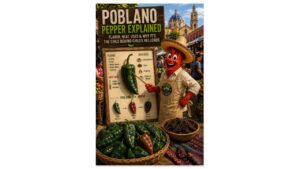
Meet the poblano pepper—Mexico’s mild, meaty chile built for roasting, stuffing, and transforming into unforgettable dishes. Discover its earthy flavor, gentle heat, Puebla roots, and why it became the pepper behind chiles rellenos.
Some peppers were born to disappear into salsa. The poblano apparently looked at that job description and asked for a bigger role.
Large, dark green, thick-walled, and mild enough to eat by the forkful, the poblano is one of those rare chiles whose physical shape helped determine its culinary destiny. Roast it and the skin blisters while the flesh underneath becomes softer, sweeter, and more deeply flavored. Slice it into strips and you have the beginning of rajas. Leave it whole and suddenly there’s room inside for cheese, meat, picadillo, or one of Mexico’s most celebrated fillings. Let the pepper fully ripen and dry it, and its identity changes again: the fresh poblano becomes an ancho chile.
This is a pepper with range.
Stand near a hot comal in a Mexican kitchen while poblano peppers are roasting and describing them simply as “mild green peppers” starts to sound almost ridiculous.
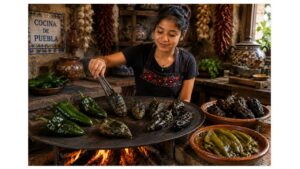
At first, the transformation is mostly visual. Glossy dark-green skin begins blistering where it touches the heat. Small blackened patches spread across the surface. The pepper softens and collapses slightly as moisture moves through its thick flesh, while an aroma that was once fresh and vegetal becomes warmer, sweeter, and unmistakably roasted. Once the poblanos have been removed from the heat and allowed to steam, their loosened outer skins can be peeled away, revealing tender green flesh ready to become rajas, salsa, soup—or something much more ambitious.
A chile relleno.
That transformation helps explain the poblano’s unusual place in Mexican cooking. Plenty of chiles are valued primarily for what they contribute after being chopped, ground, blended, or used sparingly for heat. The poblano can certainly do all of those things, but Mexican cooks also learned to treat the pepper itself as part of the architecture of a dish. Its broad body creates room for a filling. Its relatively thick flesh can withstand roasting and peeling. Its mild heat allows someone to eat most or all of a pepper without turning dinner into an endurance test. And its earthy green flavor is distinctive enough to remain present even after cheese, meat, salsa, crema, or other ingredients join the plate.
That combination helps explain why the poblano appears in foods ranging from everyday rajas con crema to the enormous family of chiles rellenos. In Puebla, the pepper takes on an especially elaborate role in chiles en nogada, where a roasted poblano surrounds a complex filling before being covered in pale walnut sauce and traditionally finished with parsley and pomegranate seeds.
Yet focusing only on what can be stuffed inside a poblano would miss half its story.
Leave the pepper on the plant and the familiar green chile continues ripening toward red, developing greater sweetness and maturity. Preserve that ripe pepper through drying and another ingredient emerges: the ancho chile, darker, sweeter, and dramatically different in aroma and culinary purpose from the fresh poblano that came before it.
Same plant.
Different moment.
Different ingredient.
Few peppers give us a better way to understand an important principle of Mexican chile cooking: a pepper’s identity isn’t determined by Scoville heat alone. Ripeness, roasting, drying, preparation, and place can matter just as much.
If you’re beginning to explore that larger world, our Chile Pepper Guide: Flavor, Heat, Uses & Individual Peppers Explained explores how individual peppers differ in flavor, heat, culinary uses, and the transformations that give them their distinctive identities. The poblano is an especially useful place to continue because its story touches almost every part of that education.
With this pepper, heat is only the beginning.
Poblano Pepper Snapshot
- Pronunciation: poh-BLAH-noh
- Spanish Name: Chile poblano
- Origin: Mexico: strongly associated with Puebla
- Species: Capsicum annuum
- Scoville Heat: Generally about 1,000–2,000 SHU
- Flavor: Earthy, vegetal, mildly sweet; richer and sweeter when roasted
- Color: Usually harvested dark green; matures toward red
- Best Uses: Roasting, stuffing, chiles rellenos, rajas, chiles en nogada, sauces, soups
- Common Forms: Fresh, roasted, peeled, sliced into rajas; mature and dried as ancho
- Best Substitute: Anaheim for many mild fresh-chile applications; the best substitute depends on whether the poblano is being roasted, stuffed, sliced, or used primarily for flavor
Quick Guide
What does a poblano pepper taste like?
Fresh poblanos have an earthy, green, mildly vegetal flavor with gentle chile heat. Roasting softens the pepper and develops sweeter, deeper, more savory flavors.
How hot is a poblano pepper?
Poblanos are generally mild, commonly measuring around 1,000–2,000 Scoville Heat Units. Individual peppers can vary, however, and occasionally a poblano delivers noticeably more heat than expected.
Why are poblano peppers used for chiles rellenos?
Their large size, broad interior, substantial flesh, and relatively mild heat make poblanos particularly well suited to roasting, peeling, stuffing, and cooking whole.
Is a poblano the same thing as an ancho chile?
They’re two forms of the same pepper. Poblano generally refers to the fresh chile. When a mature poblano is dried, it becomes an ancho chile with a darker, sweeter, more concentrated flavor.
Do you have to roast poblano peppers before eating them?
No, but roasting is one of the defining ways poblanos are prepared. High heat softens the flesh, develops deeper flavor, and blisters the tougher outer skin so it can be peeled away.
What are the best dishes to make with poblano peppers?
Chiles rellenos, chiles en nogada, rajas con crema, soups, sauces, tacos, egg dishes, casseroles, and roasted-chile preparations are all excellent uses for poblanos.
What Is a Poblano Pepper?
Pick up a poblano at a Mexican mercado and its culinary possibilities begin revealing themselves before you’ve tasted anything.
The pepper feels substantial. Its dark-green body broadens around the shoulders before tapering toward the tip, and its walls have enough thickness to survive treatment that would overwhelm more delicate chiles. Split one open and there’s enough interior space to imagine an actual filling rather than a few seeds being scraped away. Hold it over flame and that same sturdy flesh gradually softens without immediately disappearing.
Botanically, the poblano belongs to Capsicum annuum, the remarkably diverse species that includes jalapeños and many other familiar cultivated peppers. But knowing its species tells us relatively little about the role it plays in a kitchen. Culinarily, the poblano occupies an unusual space between pepper as seasoning and pepper as food.
Think about what happens with a serrano. It may be chopped into pico de gallo, roasted with tomatillos, or blended into salsa, allowing its bright flavor and sharper heat to spread throughout the dish. A poblano can be chopped and blended too, but it is substantial enough to become something else entirely: a major component of the meal.
That’s especially important because the poblano’s heat generally remains restrained. If a cook is going to place an entire roasted pepper on someone’s plate, the chile needs enough character to remain interesting while allowing the diner to taste everything else happening around it. Poblanos accomplish that balance unusually well. Their flavor is recognizably chile-forward without depending on aggressive heat, while their texture allows them to carry cheese, picadillo, vegetables, sauces, or other ingredients without becoming merely a container.
Roasting reveals the pepper’s character even more clearly.
Fresh poblano flesh can taste green, earthy, and somewhat vegetal. Direct heat begins changing that balance. As the skin chars and the pepper softens, sweetness becomes easier to notice and the flavor grows deeper and rounder. Peeling away the blistered exterior leaves behind flesh that can be sliced into rajas, folded into sauces and soups, layered onto other foods, or carefully opened for stuffing.
The same pepper can therefore move from ingredient to centerpiece depending on what the cook asks it to do.
And that’s why the Scoville number—useful though it is—doesn’t come close to explaining the poblano.
THE POBLANO’S DEFINING QUALITY ISN’T HOW MUCH HEAT IT DELIVERS—IT’S HOW MUCH COOKING IT MAKES POSSIBLE.
 🌶️ Professor Pepper Says…
When you’re learning peppers, don’t stop at “How hot is it?” Ask what its size, wall thickness, flavor, ripeness, and response to heat allow a cook to do with it. The poblano is one of the best examples of a chile whose culinary personality is much bigger than its Scoville rating.
Why Is It Called a Poblano?
To understand the name, travel to Puebla.
Here the word poblano stops sounding like the arbitrary label printed beside a pile of green peppers in the produce department. In Spanish, poblano identifies something associated with Puebla, and the chile’s identity has become deeply connected with the state and its cooking traditions.
That relationship is particularly visible in the kitchen.
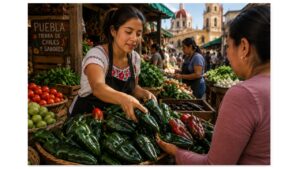
Walk through markets and food spaces in Puebla and poblanos don’t exist in only one form. They can appear fresh and glossy, blackened from roasting, peeled and waiting to be filled, or sliced into soft green rajas. Depending on the dish and season, they may be surrounded by the familiar ingredients of everyday cooking or become part of something far more elaborate.
That range matters because Puebla itself has one of Mexico’s most layered culinary traditions. Indigenous ingredients and techniques existed here long before Spanish arrival. Later came new livestock, fruits, nuts, spices, cooking practices, convent kitchens, trade, and generations of cooks who turned those encounters into foods that became distinctly regional. The poblano fits naturally into that history because it is both deeply Mexican and remarkably receptive to what cooks build around it.
Nowhere is that more visible than in chiles en nogada.
During the dish’s celebrated season, the poblano becomes the green foundation for a composition far more elaborate than the pepper alone would suggest. A roasted and peeled chile surrounds a complex picadillo traditionally incorporating meat and fruit. Pale walnut-based nogada covers the pepper, while pomegranate seeds and parsley complete one of Mexico’s most recognizable presentations.
Yet the same poblano that can carry all of that ceremony can appear on a far simpler plate.
Roast it, peel it, cut it into strips, and those strips become rajas. Add onion, crema, cheese, corn, or other ingredients and the pepper settles into the rhythms of everyday cooking. The technique is less spectacular than chiles en nogada, but it may tell us just as much about why the poblano endured. A useful ingredient doesn’t survive for generations because it can make one famous dish. It survives because cooks keep finding reasons to reach for it.
That is the more interesting relationship between the pepper and Puebla.
The region didn’t simply give the poblano a name.
Its kitchens demonstrate its range.
Celebration and everyday cooking meet in the same chile, and the distance between them may be no greater than what happens after the pepper leaves the comal.
THE NAME POBLANO POINTS TOWARD PUEBLA, BUT THE REGION’S COOKING EXPLAINS WHY THE PEPPER BECAME WORTH NAMING.
What Does a Poblano Pepper Taste Like?
Taste a poblano raw and the first thing you notice probably won’t be heat.
The pepper has a distinctly green character—fresh, vegetal, slightly earthy, and less sweet than a typical green bell pepper. There’s enough chile flavor to tell you immediately that you’re eating something different from an ordinary sweet pepper, but the poblano usually doesn’t announce itself with the sharp, immediate burn associated with serranos or hotter jalapeños.
That balance is part of its usefulness. Poblanos have enough personality to remain recognizable alongside onions, corn, crema, cheese, eggs, meat, and tomatoes without forcing every other ingredient into the background. They can support a dish or become its central ingredient depending on how they’re prepared.
But the raw pepper only tells part of the story.
Put a poblano over direct flame, beneath a broiler, or onto a very hot comal and its flavor begins to change along with its appearance. The skin blisters and blackens while the flesh underneath softens. Some of the pepper’s raw vegetal edge becomes less prominent, natural sweetness becomes easier to perceive, and the overall flavor grows deeper and more savory.
This is why “earthy” is often used to describe poblanos, but even that word only tells part of the story. Roasting transforms the pepper. The fresh, green character softens, natural sweetness becomes more noticeable, and the flesh develops the deeper, warmer flavor that makes roasted poblanos so distinctive in Mexican cooking.
Then allow the pepper to fully mature and dry it, and the transformation goes much further.
The resulting ancho develops a darker, sweeter flavor profile commonly described with dried-fruit-like qualities. We’ll explore that transformation later because it deserves more than a passing mention. For now, the important lesson is that poblano flavor exists on a continuum shaped by ripeness and preparation.
Fresh.
Roasted.
Ripe.
Dried.
The chile may begin in the same place, but the cook decides which personality reaches the plate.
A POBLANO DOESN’T HAVE ONE FLAVOR—HEAT, RIPENESS, AND PREPARATION REVEAL DIFFERENT SIDES OF THE SAME PEPPER.
How Hot Is a Poblano Pepper?
On the Scoville scale, poblanos live comfortably toward the mild end of the chile spectrum.
A typical poblano is generally cited around 1,000–2,000 Scoville Heat Units, putting it well below the usual range of a jalapeño and dramatically below a serrano. For someone accustomed to eating hot peppers, a poblano may produce little more than a gentle warmth.
That mildness is not an accident from a culinary perspective. It is one of the reasons an entire roasted poblano can become the centerpiece of a dish. Eating a whole serrano stuffed with cheese would create a very different experience.
Still, poblanos have a reputation for occasionally breaking the rules.
Anyone who cooks with them regularly may eventually encounter one pepper that seems considerably hotter than the others sitting beside it. That’s because Scoville ranges describe typical heat, not a guarantee stamped onto every individual fruit. Genetics matter, but growing conditions, plant stress, maturity, and natural variation can all influence how much capsaicin develops.
Even peppers harvested from the same plant aren’t necessarily identical.
That unpredictability can surprise people who approach poblanos as though they were simply another bell pepper. A dish containing several poblanos may be very mild, while another batch can deliver enough warmth to make itself known.
There’s another useful lesson hiding here.
Most of a chile’s capsaicin is concentrated in the pale internal tissue—the placenta—to which the seeds are attached, rather than being produced by the seeds themselves. Seeds can become coated with capsaicin from nearby tissue, which helps explain why removing the internal ribs and seeds can reduce perceived heat even though the seeds aren’t actually the primary source.
For poblanos, that means a cook has some ability to manage the experience. Opening the pepper and removing more of the internal membrane before stuffing or slicing it can make the final dish gentler, although no kitchen technique can make every naturally variable poblano taste exactly the same.
That’s part of cooking with a living agricultural ingredient.
THE SCOVILLE SCALE CAN TELL YOU WHERE POBLANOS USUALLY LIVE—IT CAN’T PROMISE HOW HOT THE NEXT ONE WILL BE.
🌶️ Professor Pepper Says…
Don’t judge chile heat by the seeds alone. Capsaicin is produced primarily in the pale internal tissue that holds them. Removing seeds often removes some attached capsaicin too, but trimming the inner ribs and placenta is more important when you’re trying to tame a pepper.
Why Roasting Changes a Poblano So Dramatically
Watch poblanos roasting over an open flame and it can look, at first, as though something has gone terribly wrong.
The goal is to blacken the skin.
A cook may turn the pepper repeatedly until much of its glossy green exterior is blistered, charred, and pulling away from the flesh beneath it. To someone unfamiliar with the technique, the chile can appear burned beyond saving.
It isn’t.
The thin outer skin of a poblano can be unpleasantly tough after cooking, so blistering accomplishes something practical: it loosens that skin enough to be peeled away. At the same time, heat is working on the flesh underneath, softening the pepper and developing the roasted flavor that defines dishes such as rajas and many chiles rellenos.
Once the pepper is evenly blistered, cooks commonly place it somewhere covered for a short period—a bowl beneath a plate, a covered container, or another enclosed space. The residual heat and moisture help the blistered skin loosen further.
Then comes the part that requires a little restraint.
The blackened exterior is rubbed or peeled away, but the goal isn’t necessarily to scrub the pepper until it looks factory-clean. Aggressively rinsing roasted poblanos under running water can wash away flavorful juices and some of the roasted character you’ve just worked to develop. A few stubborn dark flecks aren’t a culinary emergency.
For rajas, the peeled pepper can then be opened, cleaned, and sliced.
For a chile relleno, the challenge is more delicate. The cook wants to remove the skin and access the interior while keeping the pepper sufficiently intact to hold a filling. Suddenly the poblano’s thick flesh and broad shape—the physical characteristics we noticed at the beginning of this article—become important again.
The technique and the pepper fit each other.
Roasting isn’t simply something Mexican cooks happen to do to poblanos. It’s one of the techniques that reveals why this particular chile became so valuable in the first place.
CHAR THE SKIN, PROTECT THE FLESH—THE SECRET TO A ROASTED POBLANO IS KNOWING WHICH PART YOU’RE ACTUALLY TRYING TO BURN.
Why Poblanos Became the Chile Behind Chiles Rellenos
Set an unroasted poblano beside a bell pepper and a serrano and you can almost see the culinary opportunity.
The poblano occupies a useful middle ground. It is large enough to hold a substantial filling, but its flavor is more distinctly chile-like than a typical sweet pepper. Its walls are sturdy enough to withstand roasting and handling, yet they become tender enough to cut with a fork once cooked. And because its heat generally remains moderate, the diner can eat the pepper itself rather than treating it merely as seasoning.
That combination made the poblano an extraordinary candidate for chiles rellenos.
The name is wonderfully straightforward: chile relleno means stuffed chile. It describes a broad idea rather than one immutable recipe, and stuffed-chile traditions vary by region, cook, occasion, and filling.
Still, the poblano became one of the peppers most strongly associated with the dish.
Picture the process in a working Mexican kitchen. Poblanos emerge from the heat blistered and softened. Their skins are carefully peeled away. A small opening allows the seeds and internal tissue to be removed while preserving the pepper’s overall structure. Then the empty cavity—the feature that made this chile so useful from the beginning—is filled.
Sometimes that means cheese, which softens or melts as the chile cooks.
Sometimes it means picadillo or another savory filling.
Depending on the preparation, the stuffed pepper may then be coated in a light egg batter and fried until the exterior becomes golden while the roasted poblano remains soft underneath. Sauce may follow, turning the plate into something simultaneously rich, smoky, savory, and unmistakably centered on the chile.
But reducing chiles rellenos to “peppers stuffed with cheese” misses the larger tradition.
Different Mexican kitchens fill chiles differently, prepare their coatings differently, pair them with different sauces, and serve them in different contexts. The poblano provides the structure, but what happens inside and around it reflects the cook and the regional tradition.
And Puebla gives us perhaps the most dramatic demonstration of that flexibility.
Chiles en nogada begins with the same fundamental idea—a poblano capable of holding a filling—but takes it somewhere entirely different. Instead of emphasizing molten cheese and fried batter, the pepper becomes part of an elaborate seasonal composition involving picadillo, walnut sauce, pomegranate, and parsley.
The chile can handle both jobs because it was never merely a container.
Its roasted flavor remains part of the dish.
That distinction explains why substituting a large sweet pepper may reproduce the geometry of a chile relleno without reproducing its character. You still have something capable of holding cheese or meat, but you’ve changed one of the principal flavors on the plate.
The poblano isn’t packaging.
It’s dinner.
CHILES RELLENOS WORK BECAUSE THE POBLANO DOES TWO JOBS AT ONCE: IT HOLDS THE FILLING AND REMAINS ONE OF THE MOST IMPORTANT FLAVORS ON THE PLATE.

Rajas Show the Poblano’s More Everyday Side
Not every poblano needs to become a culinary centerpiece.
Walk away from the elaborate presentation of a stuffed chile and the same roasting technique leads to something much simpler: rajas, strips of roasted and peeled chile that appear throughout Mexican cooking.
The word rajas refers to strips or slices, and when people talk about poblano rajas, they’re describing a preparation that begins by doing much of what we’ve already learned. The poblanos are roasted until blistered, allowed to soften, peeled, cleaned, and then sliced lengthwise.
From there, the possibilities widen.
Cook those strips with sliced onion and the poblano’s sweetness and roasted character begin mingling with another deeply familiar kitchen flavor. Add crema and the dish becomes richer while the dairy softens the chile’s warmth. Corn kernels can bring sweetness and texture. Cheese can add saltiness and richness. Potatoes, chicken, eggs, mushrooms, or other ingredients can turn the same basic preparation in different directions.
Rajas can become a filling for tacos or quesadillas, accompany meat, appear alongside eggs, or function as part of a larger meal. They demonstrate something that the spectacular chiles rellenos can occasionally obscure: poblanos are useful precisely because they don’t require spectacle.
This is everyday versatility.
The same chile capable of carrying an elaborate filling can be roasted on an ordinary evening, sliced into strips, combined with whatever else the kitchen has available, and brought to the table without ceremony.
That contrast reveals something important about the poblano. Chiles rellenos showcase the pepper’s size, structure, and ability to carry a substantial filling, while rajas demonstrate how naturally the same chile fits into everyday cooking. One preparation turns the poblano into the centerpiece of the plate; the other slices it into something that can become part of tacos, quesadillas, eggs, vegetables, or a simple family meal.
Together, they explain why the poblano became so enduring in Mexican cooking: it can be special without needing to be reserved for special occasions.
THE POBLANO MAY BE FAMOUS FOR BEING STUFFED, BUT RAJAS SHOW WHY MEXICAN COOKS KEEP ROASTING IT EVEN WHEN NOBODY IS CELEBRATING.
When a Poblano Ripens, the Story Isn’t Over
Most shoppers in the United States meet the poblano while it is still dark green.
That familiar color can make it easy to assume we’ve reached the pepper’s finished state. We haven’t. Like many chile peppers, poblanos continue changing as they mature, eventually moving from green toward deeper shades of red. The change is more than cosmetic. As the fruit ripens, some of its youthful green character gives way to greater sweetness and a fuller, more mature chile flavor.
In Mexico, that later stage creates an entirely different culinary opportunity.
Mature red poblanos can be preserved through drying. As moisture leaves the fruit, the flesh darkens and wrinkles while its flavor becomes sweeter and more concentrated.
The result is an ancho chile.
This is one of the most useful lessons in Mexican chile cooking because grocery-store organization can make poblano and ancho look like unrelated ingredients. One sits among fresh produce: broad, glossy, green, and heavy with moisture. The other appears among dried chiles: dark reddish-brown, wrinkled, lightweight, and carrying an entirely different aroma.
Yet they represent different stages in the life of the same chile.
That relationship also explains why the words shouldn’t be treated as perfectly interchangeable in a recipe. If a dish asks for a fresh poblano, dropping in a dried ancho changes far more than terminology. Texture, moisture, sweetness, concentration, preparation, and culinary function have all changed.
The plant may be the same.
The ingredient is not.
A POBLANO DOESN’T STOP DEVELOPING WHEN IT TURNS RED—RIPENING AND DRYING OPEN AN ENTIRELY DIFFERENT CHAPTER OF THE PEPPER’S CULINARY LIFE.
Poblano vs. Ancho: What’s the Difference?
The simplest answer is also the most important:
A poblano is the fresh chile. An ancho is the mature chile after it has been dried.
But tasting them side by side reveals why Mexican cooking gives the two forms different names.
A fresh green poblano carries the earthy, vegetal chile character we’ve been following throughout this article. It contains enough moisture and structure to be roasted, peeled, sliced into rajas, or kept substantially intact for stuffing. Its physical form is central to what cooks can do with it.
An ancho no longer behaves that way.
Drying removes much of the water that gave the fresh pepper its weight and fleshy texture. The chile becomes broad, flattened, wrinkled, and pliable or brittle depending on its condition and storage. Its flavor becomes concentrated and noticeably sweeter, often developing dried-fruit-like notes alongside gentle earthiness and warmth.
That changes how the chile enters a dish.
Rather than roasting an ancho and filling it with cheese, cooks may toast it briefly to awaken its aroma, remove the stem and seeds, soften it in liquid, and blend it into sauces, marinades, adobos, moles, and other preparations where the chile becomes part of the flavor foundation.
The transformation is therefore both sensory and functional.
Fresh poblano gives you flesh.
Ancho gives you concentration.
Fresh poblano can become the food on the plate.
Ancho more often disappears into the food while helping create the flavor that defines it.
Neither form is more authentic or more important. They are two culinary identities created from the same chile at different stages of its life.
Once you understand that relationship, the dried-chile section of a Mexican mercado starts making much more sense.
POBLANO AND ANCHO BEGIN WITH THE SAME CHILE, BUT RIPENING AND DRYING CHANGE WHAT THE COOK CAN ASK THAT CHILE TO DO.
🌶️ Professor Pepper Says…
Think of “poblano” and “ancho” as culinary identities rather than two unrelated peppers. The fresh poblano is valued for its flesh, shape, and roasting qualities; the dried ancho is valued for concentrated sweetness, aroma, and the depth it can build in sauces.
Why Dry a Poblano at All?
Before refrigeration, global produce shipping, and supermarket freezers, drying was one of humanity’s great answers to a simple agricultural problem: harvests don’t last forever.
Chile peppers lend themselves particularly well to preservation, and Mexico developed an extraordinary dried-chile tradition in which removing moisture did much more than extend shelf life. Drying created ingredients with flavors and culinary uses different from their fresh counterparts.
The poblano-to-ancho transformation is a beautiful example. Allowing the pepper to mature before drying preserved the harvest while creating something the fresh chile could not provide: a shelf-stable ingredient with concentrated sweetness, earthiness, color, and aroma.
That distinction matters because dried chiles aren’t simply tools for making Mexican food hotter. Anchos are valued for the depth they contribute to sauces, marinades, adobos, moles, and other preparations without overwhelming them with heat.
The fresh poblano’s great strength is versatility rather than fire. Drying doesn’t abandon that identity.
It gives versatility another form.
DRYING A CHILE ISN’T JUST PRESERVATION—IT CAN CREATE FLAVORS THE FRESH PEPPER NEVER HAD.
Green Poblano, Red Poblano, and Ancho Are a Culinary Timeline
Imagine three peppers laid across a wooden table.
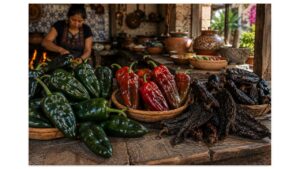
The first is glossy and dark green, firm enough to hold in your hand without bending. This is the poblano most shoppers recognize—the pepper headed toward a comal, a batch of rajas, or a chile relleno.
Beside it is a mature poblano that has been allowed to ripen toward red. It is still fresh and fleshy, but visually it already tells us the first pepper wasn’t the end of the story.
Then comes the ancho.
Dark, wrinkled, dried, and dramatically lighter, it can appear almost unrelated until you understand what happened between the three.
That progression—green poblano → ripe red poblano → dried ancho—is exactly why pepper education becomes so much more interesting once we move beyond heat charts.
The Scoville scale hasn’t explained this transformation.
Agriculture has.
Time has.
Preservation has.
And generations of cooking have given each stage a purpose.
Understanding the poblano and ancho relationship therefore gives you something more valuable than a piece of pepper trivia. It gives you a framework for understanding why Mexican cooks distinguish so carefully among fresh, ripe, dried, and smoked chiles.
THE JOURNEY FROM GREEN POBLANO TO RED POBLANO TO ANCHO SHOWS THAT A CHILE’S IDENTITY CAN CHANGE LONG AFTER IT LEAVES THE FLOWER.
How to Choose a Good Poblano Pepper
Once you know what you’re looking for, choosing fresh poblanos is relatively straightforward.
Look for peppers that feel firm and substantial for their size, with relatively taut skin and a rich green color. Natural curves, irregular shoulders, minor surface variation, and the occasional cosmetic mark aren’t reasons to reject a pepper. This is produce, not manufactured packaging.
What matters more is condition.
Avoid poblanos that feel unusually soft, deeply shriveled, slimy, or show significant damaged areas. A little wrinkling may simply indicate that the pepper has begun losing moisture, but a poblano intended for stuffing benefits from firm flesh and enough structural integrity to survive roasting, peeling, filling, and cooking.
Size matters differently depending on the job.
For chiles rellenos, broad, reasonably large poblanos with generous interior cavities are especially convenient because they’re easier to fill. For rajas, soups, sauces, or chopped preparations, perfect symmetry matters considerably less. An oddly shaped poblano tastes just as poblano-like once it’s roasted and sliced.
Color deserves some flexibility too.
Dark green is the familiar commercial stage, but reddish areas don’t automatically mean something has gone wrong. They can indicate that the fruit has continued maturing. Once you understand the pepper’s journey toward red and eventually ancho, those color changes stop looking like defects and start looking like biology.
Choose the pepper for the job you’re asking it to do.
THE BEST POBLANO ISN’T ALWAYS THE PRETTIEST ONE—IT’S THE ONE WITH THE FRESHNESS, SIZE, AND STRUCTURE YOUR DISH NEEDS.
How to Store Poblano Peppers
Fresh poblanos are best treated like other fresh chile peppers: keep them cool, dry, and protected from excessive moisture until you’re ready to use them.
In the refrigerator, unwashed poblanos can generally be kept in the produce drawer or another cool area where air circulation and humidity are reasonably controlled. Washing them immediately before cooking rather than before storage helps avoid introducing unnecessary surface moisture.
If your poblanos are beginning to soften, that doesn’t automatically mean they’re useless. A pepper that has lost enough firmness to make an elegant chile relleno difficult may still be perfectly suitable for roasting, chopping, blending into sauce, or turning into rajas.
Roasted poblanos can also be prepared ahead. Once blistered, peeled, cleaned, and cooled, they can be refrigerated for shorter-term use or frozen for longer storage. Freezing will affect texture, so a thawed pepper may be less appealing for applications where pristine structure matters, but it can still work beautifully in soups, sauces, casseroles, rajas, and other cooked dishes.
Anchos require a different approach because drying has already done the preservation work.
Keep dried anchos in a cool, dark, dry place in a well-sealed container. Good dried chiles should retain aroma and some flexibility rather than becoming dusty, flavorless relics forgotten at the back of the pantry.
Fresh or dried, the goal is the same:
Protect the qualities that make the chile useful.
What Can You Substitute for a Poblano Pepper?
The best poblano substitute depends on why the poblano is in the dish.
That distinction matters.
If you’re making a stuffed chile, you need something large enough to hold a filling and sturdy enough to survive cooking. If you’re making rajas, roasting character and flavor matter more than creating a perfect cavity. If the poblano is being chopped into soup, the exact shape barely matters at all.
For many fresh applications, Anaheim peppers are among the most practical substitutes. They’re generally mild and roast well, although their longer, narrower shape and somewhat different flavor mean they won’t reproduce a poblano perfectly—especially in a stuffed preparation.
A green bell pepper can reproduce size and mildness when heat needs to be avoided almost completely, but the flavor changes considerably. Bell peppers are sweeter and lack the distinctive earthy chile character that makes a roasted poblano taste like a poblano.
Other mild fresh Mexican chiles may work depending on availability and the dish, but chasing an exact Scoville match is the wrong approach.
Ask instead:
- Does the substitute need to be stuffed?
- Does it need to roast and peel well?
- Does the dish need earthy chile flavor?
- How much heat can the diner tolerate?
Those questions lead to better substitutions than a heat chart alone.
And if a recipe calls for ancho, don’t automatically reach for a fresh poblano simply because you now know they’re the same chile. Once dried, the ancho has developed a different moisture level, concentration, sweetness, and culinary function.
Same plant does not mean same ingredient.
THE BEST POBLANO SUBSTITUTE MATCHES THE JOB THE PEPPER IS DOING, NOT JUST THE NUMBER BESIDE IT ON THE SCOVILLE SCALE.
🌶️ Professor Pepper Says…
When substituting peppers, match culinary function before heat. A pepper that’s equally mild but too small to stuff—or too thin-walled to roast and peel—may be a much worse substitute than its Scoville rating suggests.
How to Cook with Poblano Peppers at Home
Once you understand what heat does to a poblano, cooking with one becomes much less mysterious.
You don’t need to begin with an elaborate chile relleno. In fact, one of the easiest ways to understand the pepper is simply to roast it.
Place whole poblanos over a gas flame, beneath a broiler, on a grill, or against a very hot cooking surface and turn them as the skin blisters. Once the exterior is well charred, allow the peppers to rest covered briefly so the loosened skin becomes easier to remove. Peel away the blistered exterior, remove the stem and internal tissue as appropriate for the dish, and what remains is one of the most adaptable ingredients in Mexican cooking.
Slice the roasted flesh into strips and you have the foundation for rajas. Fold those strips into scrambled eggs or tuck them into a quesadilla. Combine them with onions, corn, crema, or cheese. Add them to tacos, potatoes, beans, soups, or casseroles. Chop roasted poblano into salsa when you want chile character without the sharper heat of a serrano.
Or leave the pepper largely intact and let its shape do the work.
A roasted poblano can surround melting cheese, picadillo, vegetables, beans, or other fillings, turning the pepper from one ingredient among many into the structure around which the entire dish is built.
Poblanos also work beautifully on the grill. Their thick flesh tolerates direct heat well, and the smoky character developed over charcoal or flame naturally complements grilled steak, chicken, pork, corn, onions, and other vegetables. Chopped roasted poblano can be folded into burgers, layered onto sandwiches, added to grilled cheese, or served alongside meat without requiring the cook to recreate a traditional Mexican dish every time the peppers come home from the market.
That’s an important part of learning an ingredient from another culinary tradition.
Understanding where the poblano comes from and how Mexican cooks use it doesn’t mean the pepper becomes trapped inside a list of approved dishes. It gives you enough understanding to recognize what the ingredient does well—and then cook with it intelligently.
Roast it. Stuff it. Slice it. Blend it.
Let the poblano’s flavor determine where it belongs.
ONCE YOU LEARN TO ROAST A POBLANO WELL, ONE PEPPER OPENS THE DOOR TO DOZENS OF MEALS.
What Flavors Pair Best with Poblano Peppers?
The poblano’s mild heat gives cooks considerably more freedom than a chile whose primary contribution is capsaicin.
Roasted poblanos pair particularly well with corn, where the pepper’s earthy character meets the sweetness of maize. That relationship appears naturally in rajas preparations containing corn and in countless tacos, quesadillas, soups, and other dishes where roasted chile and tortillas meet.
Cheese and crema work for a different reason. Dairy rounds the poblano’s warmth while adding richness to its roasted flavor. It’s easy to understand why cheese-filled chiles rellenos became so satisfying: the pepper contributes enough flavor to stand against the richness rather than disappearing beneath it.
Onions and garlic deepen the savory side of the chile, while tomatoes and tomatillos can provide acidity and brightness. Cilantro, Mexican oregano, cumin in appropriate preparations, lime, beans, potatoes, mushrooms, squash, chicken, pork, and beef can all find natural places beside poblano.
Then there is fruit.
Chiles en nogada demonstrates just how far the poblano’s relatively restrained heat can stretch. A pepper that works with onions and melted cheese can also sit beneath a filling containing fruit and warm spices because its own flavor is distinctive without being overwhelmingly hot.
That versatility becomes useful when choosing hot sauce, too.
The goal isn’t necessarily to make a mild poblano dish as hot as possible. A good sauce should continue the flavor already on the plate. A bright green sauce can lift roasted poblanos and crema. A roasted or smoky sauce can reinforce grilled chile and meat. Something fruitier can work when the preparation already contains sweet elements.
The poblano gives you room to choose.
THE BEST PAIRINGS DON’T COVER THE POBLANO’S EARTHY ROASTED FLAVOR—THEY GIVE IT SOMETHING INTERESTING TO PLAY AGAINST.
🌶️ Recommended Peppers of Key West Products for Poblano Peppers
A poblano rarely needs help becoming interesting. The better question is what kind of sauce can complement the way you’re already serving it.
For creamy rajas and cheese-filled chiles rellenos, brightness and acidity can keep a rich plate from becoming heavy. Grilled poblanos and meat can handle something deeper or smokier. Tacos and quesadillas built around roasted poblano often welcome a green chile sauce that adds another layer of flavor without burying the pepper underneath it.
So rather than simply reaching for the hottest bottle available, match the sauce to the dish built around the poblano.
Product Pairing Quick Guide
- Cheese-Filled Chiles Rellenos → Peppers of Key West Cayenne Hot Sauce
- Rajas con Crema → Peppers of Key West Serrano Hot Sauce
- Poblano Tacos & Quesadillas → Peppers of Key West Jalapeno Garlic Hot Sauce
- Grilled Poblanos with Steak or Chicken → Peppers of Key West Ghost Pepper Hot Sauce
- Want to Try Several Flavor Pairings? → Peppers of Key West 5 Pack
🌶️ Best Peppers of Key West Pairings for Poblano Lovers
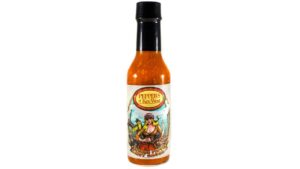
Peppers of Key West Cayenne Pepper Hot Sauce
Cayenne Pepper Hot Sauce is my pick for cheese-filled chiles rellenos, where its straightforward chile heat and tangy character can cut through the richness of melted cheese while allowing the roasted poblano to remain the star.
Best With: Cheese-filled chiles rellenos, stuffed poblanos, roasted poblano casseroles, eggs, and cheesy poblano dishes.
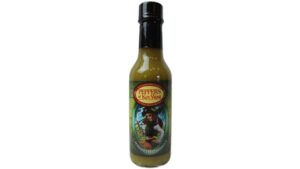
Peppers of Key West Serrano Pepper Hot Sauce
Serrano Pepper Hot Sauce brings a brighter, sharper chile kick to rajas con crema, providing a lively contrast to the creamy sauce while naturally continuing the Mexican chile flavors already on the plate.
Best With: Rajas con crema, poblano tacos, roasted vegetables, eggs, quesadillas, and creamy poblano dishes.
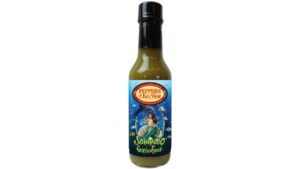
Peppers of Key West Jalapeno Garlic Hot Sauce
Jalapeno Garlic Hot Sauce is an easy match for poblano tacos and quesadillas, adding fresh green-chile character and savory garlic without overpowering the poblano’s deeper roasted flavor.
Best With: Poblano tacos, quesadillas, roasted poblano and cheese, breakfast tacos, burritos, and grilled vegetables.

Peppers of Key West 5 Pack
Can’t decide which direction to take your poblanos? The Peppers of Key West 5 Pack gives everyone at the table a chance to experiment, making it especially useful when serving chiles rellenos, rajas, tacos, quesadillas, and grilled poblano dishes together.
Best With: Poblano tasting nights, taco spreads, chiles rellenos, rajas, quesadillas, grilled foods, and anyone who wants more than one way to add heat.
Frequently Asked Questions About Poblano Peppers
Are poblano peppers hot?
Poblanos are generally considered mild chiles, commonly falling around 1,000–2,000 Scoville Heat Units. Individual peppers vary, however, and an occasional poblano can be noticeably hotter than expected.
Are poblano peppers hotter than jalapeños?
Usually no. Jalapeños typically occupy a higher Scoville range and generally produce more noticeable heat than poblanos.
Can you eat poblano peppers raw?
Yes. Raw poblanos are edible and have a crisp, green, earthy flavor. Roasting is especially popular because it softens their flesh and develops sweeter, deeper flavors.
Why do people peel poblano peppers?
The outer skin can become tough after cooking. Roasting blisters and loosens it so it can be peeled away while simultaneously softening and flavoring the flesh underneath.
Do you have to peel poblano peppers?
Not for every preparation. But for classic roasted applications such as rajas and many chiles rellenos, removing the blistered skin generally creates a more pleasant texture.
Why are some poblano peppers hotter than others?
Chile heat naturally varies according to genetics, maturity, growing conditions, environmental stress, and individual fruit. A Scoville range describes typical heat rather than guaranteeing that every poblano will taste identical.
Are poblano peppers and ancho chiles the same pepper?
Yes, but they’re different culinary forms. Poblano generally refers to the fresh chile, while ancho refers to a mature poblano that has been dried. Drying substantially changes its texture, concentration, sweetness, and uses.
Can a green poblano turn red?
Yes. Green poblanos are harvested before full maturity. If allowed to continue ripening, they can develop red coloration and greater maturity before eventually being dried to produce ancho chiles.
What is the best substitute for a poblano pepper?
Anaheim is often a useful substitute for fresh poblano because it is relatively mild and suitable for roasting. However, its shape and flavor differ. Green bell pepper can work when very mild heat is essential, but it lacks the poblano’s characteristic chile flavor.
What cheese is best for poblano peppers?
The answer depends on the dish. Mexican cheeses with good melting characteristics are natural choices for cheese-filled chiles rellenos, while other cheeses may work well in quesadillas, rajas, and contemporary preparations.
Can you freeze poblano peppers?
Yes. Poblanos can be frozen, particularly after roasting and peeling. Freezing softens their texture, so thawed peppers are especially useful for rajas, sauces, soups, casseroles, and other cooked dishes.
What is the easiest way to use poblano peppers?
Roast them, peel them, and slice them into rajas. From there, they can go into tacos, quesadillas, eggs, soups, potatoes, beans, corn dishes, sandwiches, or a simple mixture with onions and crema.
Conclusion: The Poblano Is Bigger Than Its Heat
We began beside a hot comal with a dark-green pepper blistering over the heat.
By now, that simple scene should look different.
The poblano’s blackened skin isn’t evidence of a burned pepper; it’s the beginning of one of its most important transformations. Beneath it is flesh sturdy enough to become a chile relleno, tender enough to slice into rajas, and flavorful enough to remain recognizable beside cheese, crema, corn, meat, tomatoes, onions, and salsa.
Follow the pepper back toward Puebla and its name gains geography. Follow it into the kitchen and its shape begins explaining its culinary history. Follow it longer still—past the familiar green stage toward full maturity and drying—and the poblano becomes something that can look and taste so different that Mexican cooks give it another name.
Ancho.
That journey is precisely why the poblano deserves a place in a Pepper Encyclopedia rather than merely a position on a heat chart.
It teaches us that chile peppers are agricultural ingredients before they’re Scoville numbers. Their flavor changes with maturity. Their possibilities change with technique. Their identities can change through preservation. And the dishes built around them are shaped as much by generations of cooking as by capsaicin.
Chiles rellenos may have made the poblano famous.
Rajas show how easily it belongs in everyday cooking.
Ancho reveals that the story continues even after the fresh pepper disappears.
One chile.
Several culinary lives.
THE POBLANO DOESN’T NEED EXTREME HEAT TO BE EXTRAORDINARY—IT BECAME ESSENTIAL BY GIVING COOKS MORE POSSIBILITIES.
🌶️ Continue Your Pepper Journey
🌶️ Explore Individual Chile Peppers
- Jalapeño Pepper Explained: Flavor, Heat, Uses & Why It’s America’s Favorite Chile
- Habanero Pepper Explained: Flavor, Scoville Heat, Uses & What Makes It So Hot
- Chile de Árbol Explained: Flavor, Heat, Uses & Why This Mexican Chile Packs a Fiery Punch
- Datil Pepper Explained: Flavor, Heat, Uses & Why This Pepper Is a Florida Favorite
See More Keywords
Fresh poblano pepper, Green poblano pepper, Red poblano pepper, Dried poblano pepper, Mexican poblano pepper, Puebla chile pepper, Puebla Mexico food, Capsicum annuum poblano, Mild Mexican peppers, Mexican chile peppers, Roasting chiles, Roasted Mexican peppers, Charred poblano peppers, Peeled poblano peppers, Poblano chile relleno, Chile relleno pepper, Rajas de poblano, Rajas con crema, Chiles en nogada, Poblano and corn, Poblano and cheese, Poblano tacos, Poblano quesadillas, Grilled poblano peppers, Stuffed poblano peppers, Poblano pepper recipes, Anaheim pepper substitute, Poblano vs jalapeño, Fresh poblano vs ancho, Green poblano to ancho, Dried ancho peppers, Mexican dried chiles, How poblanos become anchos
