
Orejas Explained: Mexico’s Crispy Palm Pastry That’s Impossible to Eat Just One
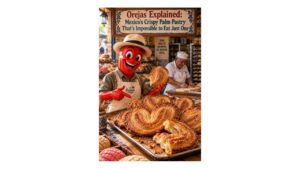
There are some Mexican bakery breads that require careful consideration. Which filling? Which topping? Which one looks freshest?
An oreja requires considerably less thought.
You pick it up. You hear the first brittle crack as you bite through the caramelized sugar. Half the pastry immediately turns into crumbs, and before you’ve finished brushing those crumbs off your shirt, you’re already looking back at the bakery tray wondering whether taking a second one would be excessive.
It would not.
That is the particular danger of the oreja, one of the simplest-looking pastries in a Mexican panadería and one of the easiest to underestimate. There is no colorful shell like a concha, no fruit filling hiding inside an empanada and no soft, buttery center waiting beneath the curved exterior of a cuernito. Instead, an oreja gives you layers of pastry, sugar, fat and heat—and somehow those few elements are enough.
During baking, the pastry expands into delicate layers while sugar melts and caramelizes across the surface. The edges become deeply crisp, the folds develop their characteristic crunch, and the two sides curl inward to create the shape that gives the pastry its wonderfully straightforward Mexican name.
Oreja means “ear.”
Once you see one, the name is difficult to forget. Once you eat one, the real problem is convincing yourself you only needed one.
Introduction: The Mexican Bakery Pastry That Makes Simplicity Look Easy
Walk into a neighborhood Mexican panadería and the orejas usually don’t have to work very hard to explain themselves. Their broad, curled shape is immediately recognizable. Layers of golden pastry sweep inward from both sides toward the center, while caramelized sugar catches the light across the surface. Some are relatively small and delicate; others are enormous enough to make the word pastry feel slightly inadequate.
What connects them isn’t an elaborate ingredient list. It’s what happens to a simple one.
Orejas belong to the larger Mexican food culture explored in Mexican Street Food Beyond Tacos: Elote, Tortas, Tamales & More, where breads and pastries are part of an everyday food landscape that extends far beyond tacos and foods cooked on the comal. Within the panadería, the oreja occupies an especially interesting position because its European ancestry is easy to recognize while its place in Mexican bakery culture feels completely ordinary.
Outside Mexico, its shape may immediately remind someone of a French palmier, the similarly curled sugar pastry whose name refers to a palm leaf. The resemblance gives us a useful historical starting point, but it doesn’t tell us what happened once this style of pastry entered Mexican bakery culture.
That is the more interesting story.
As generations of Mexican bakers incorporated European baking techniques into the enormous repertoire now associated with the neighborhood panadería, pastries were adapted, renamed and woven into Mexican daily life. As we explore in Mexican Panaderías Explained: Why Every Neighborhood Bakery Is the Heart of Mexican Morning Culture, the panadería became a place where foods from different historical origins could become completely familiar parts of the Mexican breakfast table and afternoon bakery tray. In Mexico, you don’t need to know the word palmier to recognize this pastry. You ask for an oreja.
The oreja is particularly good at revealing that process because there isn’t much decoration to distract us from what the baker is actually doing. There is no filling to provide the dominant flavor and no elaborate topping to create the personality. The baker is working primarily with dough, fat, sugar, folding, shaping and heat. Get those relationships right and a remarkably short ingredient list becomes crisp, caramelized and extraordinarily difficult to stop eating.
THE OREJA’S MAGIC DOESN’T COME FROM ADDING MORE. IT COMES FROM TURNING A FEW SIMPLE INGREDIENTS INTO CRISP LAYERS, CARAMELIZED SUGAR AND ONE OF THE MOST RECOGNIZABLE BITES IN THE MEXICAN PANADERÍA.
⚡ Quick Guide: Mexican Orejas at a Glance
What is an oreja?
An oreja is a crisp, layered Mexican bakery pastry made by folding and shaping pastry dough with sugar into its characteristic curled form before baking.
What does oreja mean in English?
Oreja means “ear” in Spanish, referring to the pastry’s broad, curled shape.
Are orejas the same as palmiers?
They belong to the same general family of folded, sugar-coated pastries and share European pastry ancestry, but the Mexican oreja developed its own identity within Mexico’s panadería tradition.
Are orejas considered pan dulce?
Yes. Orejas are commonly included within the broad world of Mexican pan dulce, or sweet bakery breads and pastries.
What do orejas taste like?
A good oreja is sweet, crisp and richly pastry-like, with caramelized sugar providing flavor and additional crunch.
When are orejas eaten?
Orejas can be enjoyed with coffee, café con leche or hot chocolate at breakfast or merienda, or simply eaten as a sweet bakery snack.
Why an Oreja Isn’t Just a Mexican Palmier
Calling an oreja a Mexican palmier is useful because it gives someone who has never seen one an immediate reference point: layered pastry, sugar and two sides curled toward the middle. But the comparison becomes limiting when it suggests that the Mexican pastry matters primarily because it resembles something European.
Mexico’s relationship with wheat bread began centuries before the modern panadería case took shape. Wheat arrived following the Spanish conquest, joining an Indigenous food culture whose foundational grain was—and remains—corn. Later European influences brought additional baking styles and pastry techniques. Over generations, Mexican bakers didn’t simply reproduce every imported bread or pastry exactly as it had been made elsewhere. Those influences became part of an expanding bakery culture with its own names, shapes, preferences and daily rituals.
The oreja makes much more sense within that larger tradition. The broader world of pan dulce makes that diversity especially clear. Pan dulce isn’t one particular dough or rigid family of recipes. It encompasses breads and pastries with remarkably different textures, ingredients, shapes and histories, and the oreja occupies the distinctly crisp end of that spectrum.
Where a concha invites you into a soft enriched crumb beneath its patterned sugar topping, an oreja announces itself through fracture. Bite into one and thin layers break into shards and crumbs while caramelized sugar adds another brittle texture across the surface. The same folding that creates its recognizable ear shape also helps establish the layers that make eating it such a wonderfully messy experience.
That is why reducing the oreja to a Mexican version of another country’s pastry misses the more interesting lesson. European pastry tradition helps explain part of where the technique came from. Mexican panadería culture explains what the oreja became.
THE EAR GETS YOUR ATTENTION. THE CRUNCH IS WHAT MAKES YOU REACH FOR ANOTHER ONE.
How Dough, Sugar and Heat Build an Oreja
An oreja looks simple on the bakery tray because most of the work that gives it character happened before it reached the oven. Its crisp layers aren’t created by a filling or topping added at the end. They begin with the way dough and fat are worked together, continue through rolling and folding, and finally become visible when heat causes the pastry to expand while sugar caramelizes around it.
This is where hojaldre becomes useful to understand. In Mexican baking, the term can refer to layered pastry doughs and preparations that produce flaky or laminated textures, although—as with many bakery traditions—the exact dough and fat can vary between bakers and regions. The basic principle is more important than insisting on one universal formula: layers of dough are separated by fat so they remain distinct rather than simply merging into one solid piece of bread.
When that layered dough enters a hot oven, water contained in the dough and fat begins turning to steam. The expanding steam pushes against the surrounding layers, helping separate them while the fat contributes richness and helps prevent those layers from bonding completely together. As the pastry sets, that expansion becomes the flaky structure we see when an oreja is broken open. That explains the layers, but sugar explains much of the personality.
Unlike pastries where sweetness is hidden inside a filling, sugar is distributed across and around the oreja as the pastry is rolled and shaped. In the oven, some of that sugar melts against the dough and baking surface before browning and caramelizing. The result isn’t simply a sweeter pastry. Caramelization creates deeper toasted flavors and, just as importantly, another brittle surface that contributes to the characteristic crack of the first bite.
A good oreja therefore depends on relationships rather than complexity. Too little separation between the layers and the pastry can become heavy. Poorly controlled heat can leave the sugar pale and the pastry underdeveloped, while excessive heat can push the sugar toward bitterness before the pastry has baked properly. The baker is trying to achieve several transformations at once: separated layers, crisp edges, browned pastry and sugar taken far enough to develop deeper flavor without burning. That sounds like a lot of responsibility for dough and sugar.
It is.
AN OREJA BECOMES CRISP NOT BECAUSE OF ONE SECRET INGREDIENT, BUT BECAUSE LAYERS, FAT, SUGAR AND HEAT ARE MADE TO WORK TOGETHER.
🌶️ Bring a Little Sweet Heat to the Table
Orejas may be built around pastry and caramelized sugar, but sweet foods can be surprisingly good partners for fruit-forward chile flavors. Peppers of Key West carries sweet and spicy sauces that can add fruit, gentle heat and contrast to desserts, breakfast pastries and bakery-inspired treats—without turning every bite into a heat challenge.
How Bakers Create the Familiar Ear Shape
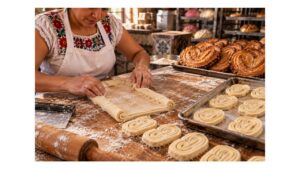
The name oreja makes considerably more sense once you watch one being formed. The dough is rolled into a broad sheet, sugar is distributed across the surface, and the two sides are brought inward toward the center. Depending on the baker and method, this can involve folding or rolling the sides in stages until two layered curls meet along the middle.
The resulting length of dough doesn’t look particularly dramatic until the baker slices across it. Each cross-section suddenly reveals the basic pattern that will become an oreja: two curled sides facing one another with a narrow connection at the center. Once those slices are arranged flat on a baking sheet, the shape is already visible, but the oven exaggerates everything. Layers expand, the curled halves spread outward, sugar melts across the surface and the pastry broadens into the familiar form that inspired someone, very sensibly, to call it an ear.
There is a practical elegance to the method as well. The baker isn’t individually sculpting elaborate pastries from scratch. A single prepared length of folded dough can be sliced repeatedly, producing multiple pieces with the same underlying form while still allowing small differences in size, curvature and caramelization. Those variations are part of what makes a bakery tray of orejas more appealing than a row of perfectly identical factory pastries.
Some emerge compact and tightly curled, while others spread dramatically and become broad, thin and exceptionally crisp. One side may brown slightly more than the other, or an outer edge may develop a darker ribbon of caramelized sugar. The basic shape provides the identity without requiring every oreja to look exactly alike. It is an idea that appears throughout the Mexican bakery case: recognizable forms create continuity while individual bakers, recipes and ovens leave their fingerprints on the finished pastry.
 🌶️ Professor Pepper Says…
Don’t judge an oreja by perfect symmetry. Slight differences in spreading, browning and caramelization are normal in bakery-made pastries—and those darker caramelized edges may deliver some of the best bites.
THE OREJA GETS ITS NAME FROM THE SHAPE THE BAKER CREATES, BUT THE OVEN IS WHAT TURNS THAT SHAPE INTO SOMETHING WORTH EATING.
Why Caramelized Sugar Matters as Much as the Pastry
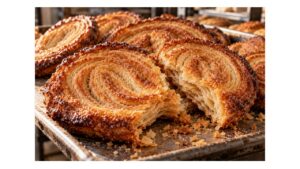
It would be easy to describe an oreja primarily as a flaky pastry, but doing so ignores half of what makes eating one distinctive. The pastry supplies the layers; the sugar changes both their flavor and the way they break beneath your teeth. As the oreja bakes, moisture disappears from its surface while exposed sugar melts and browns. Where sugar collects more heavily along an edge or against the baking surface, the pastry can develop a thin, brittle crust that fractures differently from the layers underneath it. One bite can therefore produce several textures at once.
This is also why the darkest parts of a well-baked oreja can be particularly good. Deep golden brown doesn’t automatically mean burned. Proper browning brings toasted and caramel-like flavors that balance what might otherwise be an overwhelmingly sweet pastry. Against the richness of the fat and relatively mild flavor of the dough, those darker surfaces give the oreja considerably more complexity than its short ingredient list would suggest.
The effect is especially noticeable around the outer curves, where exposed edges can become thinner and darker than the center, producing some of the most brittle bites on the pastry. Move inward and the layers may become slightly thicker and more substantial. Instead of delivering one uniform crunch from edge to edge, a good oreja moves between shattering crispness, flaky pastry and concentrated pockets of browned sugar.
And then there are the crumbs. They are unavoidable. An oreja that survives an entire cup of coffee without leaving evidence on the plate, table or your shirt should probably be investigated. The mess isn’t a defect; it’s physical evidence of the structure the baker worked to create. Thin, dry layers fracture when bitten rather than compressing like soft bread, while brittle sugar breaks away from the surface. The same characteristics that make an oreja inconvenient to eat neatly are precisely the ones that make it so satisfying to eat.
A GREAT OREJA DOESN’T JUST TASTE SWEET. IT CRACKS, FLAKES AND LEAVES ENOUGH CRUMBS BEHIND TO PROVE YOU WERE THERE.
How European Pastry Became Part of the Mexican Panadería
The oreja carries a visible clue to its history every time it appears on a bakery tray. Its folded layers and curled shape connect it to a broader European pastry tradition, particularly the family of pastries commonly known as palmiers in France. But tracing that resemblance is only the beginning, because the history of Mexican baking is not a story of one European pastry arriving in Mexico, receiving a Spanish name and remaining unchanged.
Wheat itself arrived in Mexico with the Spanish during the colonial period, entering a food culture built overwhelmingly around maize. Bread followed wheat, but the bakery traditions that eventually filled Mexican panaderías developed over centuries as Spanish techniques were joined by later European influences and adapted to Mexican ingredients, tastes, labor and everyday eating habits. By the time French baking became particularly influential in Mexico during the nineteenth century, the country already had a long and evolving relationship with wheat bread.
French influence nevertheless left an important mark. Techniques involving enriched doughs, layered pastries and decorative bakery work became part of an increasingly diverse baking culture, especially as professional bakers incorporated European methods into foods made for Mexican customers. What happened afterward is more important to the oreja than trying to identify a single moment when someone supposedly baked the first one.
Mexican bakers absorbed those techniques into a bakery vocabulary that became extraordinarily large. European ancestry remained visible in some breads and pastries, but names, proportions, ingredients and textures could change as bakers made them for local communities. A pastry known elsewhere for resembling a palm leaf could enter the Mexican bakery case and become recognizable as something else entirely.
An ear.
That wonderfully literal name tells us something about the way Mexican pan dulce developed. Bakery names often make the display case feel less like a formal pastry catalog and more like a collection of familiar objects, animals and shapes. Conchas resemble shells. Cuernos resemble horns. Orejas resemble ears. The names help customers recognize breads visually even when the recipes behind them vary from bakery to bakery.
The result is a tradition in which foreign influence and Mexican identity are not opposites. A baking technique can have roots outside Mexico while the food made from it becomes deeply embedded in Mexican life. The oreja does not need an ancient Indigenous origin to be authentically Mexican any more than the panadería itself needs to erase the European history of wheat and pastry. Its Mexican identity comes from what generations of bakers and customers did with those influences after they arrived.
THE OREJA’S EUROPEAN ANCESTRY EXPLAINS THE TECHNIQUE. GENERATIONS OF MEXICAN BAKERS AND PANADERÍA CUSTOMERS EXPLAIN WHY IT BELONGS IN MEXICO.
From Palmier to Oreja: Similar Shape, Different Bakery Life
The palmier comparison becomes more useful again once we stop treating it as a question of which pastry is the “original” and instead look at how foods develop in different environments. Both pastries can begin with layered dough, sugar and a double curl. Both depend heavily on the contrast between flaky pastry and caramelized sweetness. Visually, the family resemblance can be unmistakable.
What changes is the world surrounding the pastry.
A Mexican oreja sits in a panadería beside conchas, empanadas, cuernitos, puerquitos and an enormous assortment of other breads and pastries. It may be selected with metal tongs and placed on a tray along with several completely different pieces of pan dulce before being carried to the counter. It might become breakfast with coffee, an afternoon merienda or the pastry somebody brings home because walking past the bakery without buying anything proved impossible.
That context matters because food identity is built from more than ingredients. A recipe can tell us how flour, fat and sugar are assembled, but it cannot fully explain what a food means in everyday life. The oreja’s place in the Mexican bakery case, its Spanish name and its familiarity to generations of customers all contribute to an identity that the word palmier alone cannot capture.
This also helps explain why we shouldn’t demand that every Mexican oreja conform to one rigid European pastry standard. Some bakery versions emphasize thinness and brittle caramelization. Others can be thicker, larger or somewhat more substantial through the center. The amount of sugar, degree of browning and size of the finished pastry can vary as well. What customers recognize across those differences is the combination of the curled ear shape, layered pastry and sweet, crisp character.
A neighborhood panadería develops its own character through the bakers who work there, the customers they serve and the recipes and techniques that become part of the house style. That is why the same familiar pastry can look slightly different from one bakery to another: one oreja may be thin and deeply caramelized, another thicker and more substantial, yet both remain immediately recognizable. Rather than asking whether every version matches a textbook palmier layer for layer, the more useful question is whether the baker has created the crisp layers, caramelized sugar and satisfying fracture that make you want another bite.
A PALMIER HELPS US RECOGNIZE THE OREJA’S FAMILY TREE. THE PANADERÍA TELLS US WHERE THE OREJA BUILT A LIFE OF ITS OWN.
Why Orejas Belong in the World of Pan Dulce
The phrase pan dulce can be confusing if it is translated too literally as “sweet bread.” An oreja doesn’t behave much like bread when you bite it. It shatters rather than compresses, scatters crumbs rather than exposing a soft crumb, and owes much of its character to laminated pastry technique and caramelized sugar.
Yet it belongs comfortably in the Mexican pan dulce tradition because that tradition is much broader than a single type of dough. Pan Dulce Explained: Mexico’s Sweet Bread Tradition Beyond the Famous Concha explores that diversity in depth: the bakery case can contain soft enriched breads, decorated breads, cookies, filled pastries, layered pastries and other sweet baked foods that differ dramatically in construction while sharing a place in Mexican bakery culture.
Put a concha beside an oreja and the contrast becomes obvious. The concha is soft and tender beneath its patterned sugar crust; the oreja is thin, layered and crisp. A sweet empanada encloses fruit, pumpkin or cajeta inside dough; the oreja needs no filling at all. A cuernito may be soft, buttery or layered depending on the bakery; the oreja depends much more heavily on crispness for its identity.
Those differences are precisely why the Mexican bakery tray is so interesting. Choosing pan dulce isn’t necessarily choosing among several flavors of the same basic bread. You can choose among entirely different eating experiences.
The oreja contributes the crunch.
And after conchas, empanadas and cuernitos have given us soft bread, fillings and buttery richness, that tray could use it.
🌶️ Professor Pepper Says…
Think of pan dulce as a bakery tradition rather than a single recipe category. An oreja and a concha can have completely different doughs and textures while still belonging naturally on the same Mexican bakery tray.
PAN DULCE ISN’T DEFINED BY ONE DOUGH. THE OREJA EARNS ITS PLACE BY BRINGING SOMETHING THE SOFTER BREADS CANNOT: LAYERS THAT SHATTER WHEN YOU BITE THEM.
Why Orejas Change from One Panadería to Another
Once you know the basic formula behind an oreja, the differences across bakery trays become easier to notice. One panadería may sell broad, relatively thin orejas with deeply browned outer curves and an almost brittle crunch. Another may make them smaller and thicker, leaving more pastry between the caramelized surfaces. Sugar can range from a light crystalline coating to a darker, more thoroughly caramelized crust, while the center curl may be tightly compressed or allowed to spread considerably during baking.
Those differences can begin before the pastry ever reaches the oven. The dough itself matters, as does the type and amount of fat, the thickness to which it is rolled, the amount of sugar incorporated during shaping and the way the two sides are folded toward the center. Slice the prepared dough more thickly and the finished oreja can retain a more substantial center; slice it thinly and give it room to spread, and the result can become broader and more brittle. Oven temperature, baking time and even the surface on which the pastry bakes influence how quickly the sugar browns and how deeply the edges caramelize.
None of this means the oreja lacks an identity. In fact, the opposite is true. Its identity is strong enough to survive those differences. The curled ear shape, visible layers, sugar and characteristic crispness give bakers room to adjust the pastry without making it unrecognizable. Customers can look across a bakery case filled with dozens of different breads and still know which one is the oreja.
That variation also makes comparisons between bakeries genuinely interesting. A customer who prefers deeply caramelized edges may gravitate toward a darker, thinner version, while someone who wants more pastry between the crisp surfaces may prefer a thicker oreja. Neither preference requires declaring one bakery’s interpretation universally correct. What matters is whether the baker has controlled the dough, sugar and heat well enough for that particular version to deliver what it promises.
THE SHAPE TELLS YOU IT’S AN OREJA. THE BAKER DECIDES HOW THIN, DARK, CRISP AND CARAMELIZED THAT OREJA WILL BECOME.
How to Recognize a Great Oreja
The easiest place to begin is with the surface. A good oreja should look baked rather than merely dried. Golden brown pastry, darker caramelized edges and visible layers are encouraging signs because they suggest that enough heat reached the pastry to develop both texture and flavor. An unusually pale oreja may still be crisp, but it is less likely to have the toasted complexity that makes caramelized sugar so important to the experience.
Next, look at the layers. They don’t have to resemble the perfectly uniform interior of a technical pastry-school demonstration, but they should remain visibly distinct. The outer curves should appear crisp rather than doughy, and the pastry should feel relatively light for its size. Pick one up and you may already hear a faint crackle or see a few crumbs escape before you’ve taken a bite.
The real test comes when you break it. A well-made oreja should resist briefly and then fracture, exposing thin layers rather than bending like soft bread. The edges may shatter more dramatically while the thicker center provides slightly more substance. Sugar should contribute its own brittle texture without forming such a hard shell that it overwhelms the pastry underneath.
Flavor follows the same principle of balance. Sweetness should be obvious—this is pan dulce, after all—but sugar shouldn’t be the only thing you taste. Browning should bring toasted and caramel-like notes, while the pastry underneath contributes richness. If every bite tastes simply of white sugar, much of the potential complexity has been left in the oven.
And those dark edges deserve another look before you reject them. There is a difference between burned and deeply caramelized. Burned sugar becomes unpleasantly acrid; well-browned sugar develops a slight bitterness that can make the sweetness around it taste more interesting. On an excellent oreja, the darkest outer curl may be the piece somebody quietly breaks off before anyone else gets to it.
🌶️ Professor Pepper Says…
Don’t automatically choose the palest oreja on the tray. Golden pastry and darker caramelized edges usually mean more developed flavor—as long as the sugar has browned rather than burned.
A GREAT OREJA SHOULD LOOK LIKE THE OVEN ACTUALLY HAD SOMETHING TO SAY ABOUT IT.
Orejas, Coffee and the Mexican Bakery Ritual
For all the technique required to make an oreja properly, eating one is wonderfully uncomplicated. Put it on a plate, pour something warm to drink and accept that there will probably be crumbs.
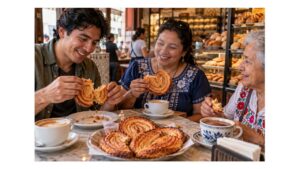
Coffee is an especially natural companion because bitterness provides contrast to caramelized sugar and rich pastry. Café con leche softens that contrast with milk, while Mexican hot chocolate moves the pairing in a richer, sweeter direction. The oreja works with all of them because its defining texture remains distinct beside a warm drink: crisp pastry, dissolving sugar and whatever is in the cup each contribute something different to the bite.
There is also the temptation to dip. A brief dip into coffee or hot chocolate softens the outermost layers and begins dissolving the caramelized sugar while leaving the center relatively crisp. Hold it there too long and pastry engineering gives way to gravity, which is a lesson best learned before half an oreja disappears into your coffee. The ideal bite catches that transition between softened edge and brittle center without sacrificing the very crunch that made you choose an oreja in the first place.
That makes orejas equally comfortable at breakfast and later in the day. Mexican bakery culture isn’t confined to one formal morning meal, and a piece of pan dulce can accompany coffee during an afternoon break or merienda just as naturally as it can appear on the breakfast table. An oreja is particularly well suited to those informal moments because it needs no preparation, filling or accompaniment to feel complete. The bakery already did the complicated part.
There is also something inherently communal about a box or bag of assorted pan dulce arriving at a table. Everyone develops preferences. Someone reaches immediately for the concha. Someone searches for the filled pastry. And someone spots the broad caramelized oreja leaning against the side and decides that particular piece has already been claimed.
The danger comes when there is only one.
Unlike a soft bread that can be neatly divided, an oreja doesn’t always cooperate with diplomacy. Break it in half and the table receives a small demonstration of pastry physics: flakes scatter, sugar cracks and the two resulting pieces may bear only a passing resemblance to equal portions.
Perhaps that explains why buying another one is often the more civilized solution.
THE OREJA MAY BEGIN AS A TECHNICAL EXERCISE IN LAYERS, FOLDING AND CARAMELIZATION, BUT AT THE TABLE ITS JOB IS MUCH SIMPLER: CRUNCH, CRUMBLE AND MAKE THE COFFEE TASTE BETTER.
Do Mexican Orejas Come in Different Flavors?
The classic oreja has remarkably little reason to reinvent itself. Sugar, browned pastry and crisp layers already provide the experience people expect, so many bakery versions remain relatively simple. That simplicity is worth protecting because once fillings, heavy frostings or elaborate toppings dominate the pastry, they can begin covering the caramelization and flaky structure that make an oreja interesting in the first place.
That doesn’t mean every oreja is identical. Even without adding another flavor, changing the amount of sugar, thickness of the pastry or degree of browning can noticeably alter the finished result. Some versions emphasize a lighter sweetness and more delicate pastry flavor, while others push caramelization further and develop darker, almost candy-like edges. Size matters too: a broad, thin oreja can deliver more brittle surface area, while a thicker version may retain more substantial pastry through its center.
Chocolate is one of the most natural departures from the classic. Some bakeries coat or dip part of the finished pastry in chocolate, adding bitterness and richness while leaving enough exposed oreja for its crisp layers to remain recognizable. The key is proportion. A partial coating can create contrast; burying the entire pastry beneath a heavy topping risks turning its most distinctive qualities into background texture.
Other contemporary bakery versions may experiment with additional coatings or flavors, but those are better understood as variations on the oreja rather than requirements of the form. The classic pastry remains a useful benchmark precisely because it has nowhere to hide. When dough, sugar, folding and baking are handled well, it doesn’t need much else.
THE BEST OREJA VARIATIONS ADD SOMETHING TO THE CRUNCH AND CARAMELIZATION WITHOUT COVERING UP THE REASON THE PASTRY WORKS IN THE FIRST PLACE.
How to Store and Reheat Orejas Without Losing the Crunch
Orejas are at their best when fresh because crispness is one of the first qualities time and moisture begin to attack. Their thin layers readily absorb humidity from the surrounding air, and once that happens, the pastry can move from brittle and flaky toward soft or chewy. The flavor may still be pleasant, but much of the experience has disappeared.
For short-term storage, the goal is therefore to keep moisture away rather than trapping it with the pastry. Once completely cool, orejas are best kept in a dry, well-sealed container at room temperature. Refrigeration generally isn’t helpful for maintaining their texture because the humid environment can work against the crisp layers we’re trying to preserve. If the pastries contain perishable toppings or fillings, of course, those additions can change the storage requirements.
If yesterday’s oreja has lost some of its snap, gentle oven reheating can often restore more of its original character. A few minutes of dry heat can drive off some absorbed moisture and re-crisp the exterior far more effectively than a microwave. Microwave energy may make the pastry warm quickly, but warmth and crispness are not the same thing; laminated pastry can become soft or chewy instead of returning to that brittle first-bite fracture.
Letting a reheated oreja cool briefly can help as well. Melted or softened sugar and fat need a moment to set again, and the pastry may actually become crisper during those first few minutes out of the oven. The objective isn’t to rebake it until the edges become darker. It is simply to restore enough dryness that the layers remember what they were supposed to do.
And what they’re supposed to do is make a mess.
AN OREJA CAN SURVIVE UNTIL TOMORROW. WHETHER YOU HAVE THE SELF-CONTROL TO TEST THAT THEORY IS A DIFFERENT QUESTION.
🌶️ A Little Sweet Heat for the Bakery Table
A classic oreja doesn’t need sauce. Its appeal comes from crisp pastry and caramelized sugar, and a freshly baked one is probably best experienced exactly as the baker intended. But when orejas become part of a larger breakfast or dessert spread, fruit-forward sauces can introduce another layer of flavor without burying the pastry beneath aggressive chile heat.
That distinction matters. The goal isn’t to pour hot sauce over an oreja until nobody remembers what came from the panadería. It is to use a small amount of fruit, acidity or gentle heat as a contrasting accent—particularly when coffee, chocolate, fresh fruit, ice cream or other accompaniments are already part of the table.
Orejas are a particularly good reminder that pairing with chile doesn’t always mean making something noticeably hot. Sometimes the better move is simply giving caramelized sugar something brighter to play against.
🌶️ Recommended Peppers of Key West Products for Mexican Orejas
- Classic Caramelized Orejas → Peppers of Key West Cherry Pomegranate Grilling Sauce
- Orejas with Berries or Vanilla Ice Cream → Fischer & Wieser’s Roasted Raspberry Chipotle Sauce
- Orejas with Tropical Fruit → Peppers of Key West Tropical Rum, Pineapple & Raisin Hot Sauce
- Orejas with Mango or Pineapple → Catch a Fire’s Mangolian Sweet Heat Pepper Sauce
Best Sweet & Spicy Pairings for Mexican Orejas

Peppers of Key West Cherry Pomegranate Grilling Sauce
The dark-fruit character of cherry and tart pomegranate makes this one of the most natural matches for a classic oreja. Caramelized sugar already provides deep sweetness and slightly toasted flavors, so a small amount of fruit-forward acidity gives the pastry contrast rather than simply adding more sugar.
Best For: Classic Caramelized Orejas

Fischer & Wieser’s Roasted Raspberry Chipotle Sauce
Once an oreja becomes part of a plated dessert with berries or vanilla ice cream, raspberry becomes a particularly useful bridge. The fruit complements the dessert components while chipotle introduces a smoky counterpoint to the caramelized pastry.
Best For: Orejas with Berries or Vanilla Ice Cream

Peppers of Key West Tropical Rum, Pineapple & Raisin Hot Sauce
Pineapple and raisin naturally move the pairing toward a more tropical dessert plate, while rum fits comfortably alongside browned sugar and pastry. This makes considerably more sense beside pineapple, banana or other tropical fruit than it would poured indiscriminately over a plain oreja.
Best For: Orejas with Tropical Fruit

Catch a Fire’s Mangolian Sweet Heat Pepper Sauce
This is the pairing for someone who actually wants the chile to announce itself. Mango-style sweetness connects naturally with tropical fruit, while the hotter pepper profile provides considerably more contrast than our gentler fruit-forward pairings.
Best For: Orejas with Mango or Pineapple
These are optional Peppers of Key West serving pairings rather than traditional oreja toppings; a great bakery-fresh oreja needs nothing more than the crumbs it creates.
THE BEST OREJA PAIRING DOESN’T COVER THE CARAMELIZED SUGAR AND CRISP LAYERS. IT ADDS JUST ENOUGH FRUIT, ACIDITY OR HEAT TO MAKE THOSE QUALITIES EVEN MORE NOTICEABLE.
Explore More of the Mexican Panadería
Orejas may be one of the crispiest choices in the bakery case, but they represent only one corner of Mexico’s remarkably diverse baking tradition. Explore the broader world of pan dulce, see how cuernitos turn the familiar horn shape into several different bakery styles, or discover how sweet Mexican empanadas adapt their dough around fillings such as fruit, cajeta and pumpkin. And to understand how all of these breads and pastries fit into everyday Mexican life, step inside the culture of Mexican panaderías, where the bakery case brings all of these traditions together.
Each teaches something different. Pan dulce reveals the enormous range hidden beneath one familiar category. Cuernitos show how a recognizable shape can survive while dough and texture change. Sweet empanadas demonstrate how a pastry can be built around its filling. Orejas take us in almost the opposite direction: they show how much a baker can accomplish with layers, sugar, fat and heat.
TOGETHER, THEY SHOW THAT THE MEXICAN PANADERÍA ISN’T BUILT AROUND ONE KIND OF BREAD OR PASTRY. IT IS BUILT AROUND AN EXTRAORDINARY RANGE OF WAYS TO TRANSFORM DOUGH.
Conclusion: Why the Oreja Deserves More Attention Than Its Simple Ingredients Suggest
An oreja is easy to underestimate. Put one beside a brightly decorated concha or a plump fruit-filled empanada and it can look almost restrained: browned pastry, caramelized sugar and a shape that resembles an ear. There is no filling waiting inside and no elaborate topping competing for attention. What you see is essentially what you get.
But that simplicity is exactly what makes the oreja such a useful pastry for understanding Mexican baking. With fewer places to hide, the baker has to create character through technique. The dough must produce distinct layers. The folds must create the familiar double curl. Sugar has to caramelize deeply enough to develop flavor without crossing into bitterness, while the pastry itself has to bake until crisp enough to fracture rather than simply bend.
Those transformations happen together. Fat separates the layers, heat creates steam and expansion, sugar melts and browns, and the oven turns a relatively plain piece of folded dough into something brittle, flaky and deeply caramelized. Take away that transformation and you still have pastry and sugar, but you don’t really have the experience that makes an oreja memorable.
Its history tells a similarly layered story. The oreja belongs to a broader European family of folded pastries, but identifying that ancestry doesn’t fully explain the food sitting in a Mexican bakery case today. Mexican bakers incorporated those techniques into the panadería, gave the pastry a wonderfully literal Spanish name and made it part of an everyday bakery culture alongside conchas, cuernos, empanadas and dozens of other breads and pastries with entirely different textures and traditions.
That may be the most interesting thing about the oreja. It doesn’t need to be the most colorful pastry on the tray or the most complicated recipe in the bakery. It simply has to do a few things exceptionally well.
It should be crisp.
It should be caramelized.
And when you bite it, there should probably be crumbs everywhere.
THE OREJA PROVES THAT ONE OF MEXICO’S MOST MEMORABLE BAKERY TREATS DOESN’T NEED A COMPLICATED FILLING OR DECORATION. SOMETIMES SUGAR, FAT, DOUGH AND HEAT ARE MORE THAN ENOUGH.
Frequently Asked Questions About Mexican Orejas
What is a Mexican oreja?
An oreja is a crisp, layered Mexican bakery pastry made by folding or rolling pastry dough with sugar into a distinctive double-curl shape before slicing and baking it until golden and caramelized. The Spanish word oreja means “ear,” referring to the pastry’s recognizable shape.
Are orejas the same as palmiers?
They belong to the same broad family of ear- or palm-shaped layered pastries and share similar folding and caramelization techniques. In Mexico, however, the oreja has developed its own identity within panadería and pan dulce culture.
Why are they called orejas?
Oreja means “ear” in Spanish. When the folded dough is sliced crosswise, the two curled sides create a shape that resembles an ear.
Are orejas considered pan dulce?
Yes. Although an oreja is crisp and pastry-like rather than soft and bread-like, it belongs naturally within Mexico’s broad pan dulce tradition. Pan dulce encompasses many different doughs, shapes, textures and baking techniques.
What do Mexican orejas taste like?
A classic oreja tastes buttery or richly pastry-like, sweet and noticeably caramelized. Well-baked versions can develop deeper toasted flavors around their darker edges while remaining lighter and more delicate through the inner layers.
Why are orejas so crispy?
Their crispness comes from thin layers of dough separated by fat, combined with moisture escaping during baking and sugar caramelizing across the surface. Proper baking produces the characteristic brittle fracture and flaky layers.
Do all Mexican orejas use the same dough?
No. Recipes and bakery methods can vary, including the type of layered dough, fat, thickness, amount of sugar and degree of caramelization. The recognizable ear shape and crisp layered character are more consistent than one universal formula.
When do people eat orejas in Mexico?
Orejas can be eaten at breakfast, with coffee or hot chocolate, during merienda or simply as a bakery snack. They are also commonly at home among an assortment of pan dulce rather than being reserved for a particular occasion.
Can you dip an oreja in coffee?
Absolutely. Coffee and café con leche pair naturally with the caramelized sweetness of an oreja. A quick dip softens the outer layers while allowing some of the crisp center to remain.
How should orejas be stored?
Once completely cool, plain orejas are best protected from moisture in a well-sealed container at room temperature. Humidity is the enemy of the crisp, flaky texture that defines the pastry.
Can you reheat an oreja?
Yes. Brief, gentle reheating in an oven can help restore crispness by removing absorbed moisture. A microwave is less effective because it tends to soften layered pastry rather than restore its brittle texture.
What makes a really good oreja?
Look for visible layers, a golden surface, deeper caramelization around some edges and a pastry that feels relatively light for its size. The first bite should fracture and flake rather than bend like soft bread.
🌮 Continue Your Mexican Street Food Journey
🥐 More Mexican Bakery Favorites Worth Exploring
- Pan Dulce Explained: Mexico’s Sweet Bread Tradition Beyond the Famous Concha
- Cuernitos Explained: Mexico’s Buttery Bakery Favorite That Makes Every Breakfast Better
- Sweet Mexican Empanadas Explained: The Bakery Pastries Filled with Fruit, Cajeta & Pumpkin
- Mexican Panaderías Explained: Why Every Neighborhood Bakery Is the Heart of Mexican Morning Culture
- Bolillos Explained: The Crispy Bread That Built Mexico’s Favorite Sandwiches
- Mexican Sandwich Bread Explained: Bolillos, Teleras, Cemitas & More
🌶️ Expand Your Mexican Food Journey
- Pepper Encyclopedia Explained: Flavor, Heat, Uses & the Complete Guide to Chile Peppers
- Datil Pepper Explained: Flavor, Heat, Uses & Why This Pepper Is a Florida Favorite
- Jalapeño Pepper Explained: Flavor, Heat, Uses & Why It’s America’s Favorite Chile
See More Keywords
orejas bakery, oreja bread, oreja pan dulce, Mexican palmier, Mexican palmiers, Mexican bakery breads, Mexican bakery sweets, traditional Mexican pastries, Mexican sweet pastries, Mexican breakfast pastries, panadería pastries, panadería orejas, Mexican bakery culture, Mexican pastry names, ear-shaped pastry, palmier pastry Mexico, crispy pan dulce, flaky Mexican pastry, caramelized sugar pastry, layered Mexican pastry, hojaldre Mexican pastry, Mexican pastry with sugar, Mexican pastries with coffee, Mexican breakfast bread, Mexican merienda, Mexican panadería, types of pan dulce, traditional pan dulce, Mexican sweet bread varieties, Mexican bakery favorites
