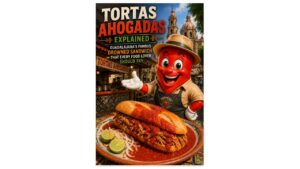
Tortas Ahogadas Explained: Guadalajara’s Famous Drowned Sandwich That Every Food Lover Should Try
Most sandwiches spend their entire lives trying not to get soggy.
Guadalajara looked at that rule and apparently decided it was cowardice.
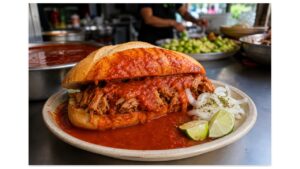
Meet the torta ahogada, Jalisco’s gloriously messy “drowned sandwich” built from crusty birote salado, juicy pork carnitas, tomato sauce, chile de árbol heat, onions, and enough sauce to make eating one gracefully almost impossible. But this isn’t some gimmicky sandwich invented for social media. Tortas ahogadas are woven into Guadalajara’s culinary identity, where locals have been eating them for generations and arguing about the proper amount of chile long before anyone thought to film the experience. So grab a fork, several napkins, and whatever confidence you have left—we’re heading to Guadalajara to discover why drowning a perfectly good sandwich turned out to be an absolutely brilliant idea.
Walk through Guadalajara around lunchtime and eventually you’ll encounter a sandwich that appears to have lost a fight with a bowl of salsa.
That’s exactly the point.
The torta ahogada—literally a “drowned sandwich”—is one of Guadalajara’s defining foods and one of the most recognizable specialties of Jalisco. At its traditional core is birote salado, the crusty regional bread capable of standing up to an amount of sauce that would reduce an ordinary sandwich roll to mush. The bread is typically filled with pork carnitas and then partially or completely submerged in a seasoned tomato sauce, with fiery chile de árbol sauce allowing the heat level to climb considerably higher. Onion and lime commonly finish the experience. Jalisco’s tourism authority describes the torta ahogada as an emblematic Guadalajara dish and specifically identifies birote salado, pork carnitas, tomato sauce, and spicy chile de árbol from Yahualica among its defining components.
That combination sounds simple.
It isn’t.
The bread has to be sturdy enough to absorb sauce without immediately disintegrating. The carnitas need enough richness to stand up against tomato, acidity, and chile heat. The sauce needs enough liquid to penetrate the sandwich while still carrying substantial flavor. And the chile can’t merely make everything hot—it needs to complement the pork and tomato rather than bury them.
When those pieces work together, the result sits somewhere between sandwich, plated street food, and wonderfully controlled culinary disaster.
But the torta ahogada is important for another reason.
It belongs unmistakably to Guadalajara.
Just as birria tells part of Jalisco’s ranching story, tortas ahogadas tell another side of the region’s culinary identity—one built around neighborhood food stands, carnitas, local bread, chile, and a preparation so closely associated with Guadalajara that eating one has become part of experiencing the city itself. Jalisco tourism describes the torta ahogada as a source of local gastronomic pride, while Mexico’s agriculture ministry traces the dish to Guadalajara roughly a century ago.
And that’s exactly why this sandwich belongs in our larger exploration of Mexican Street Food Beyond Tacos: Elote, Tortas, Tamales & More. Mexico’s street-food story becomes considerably more interesting once we move beyond tacos and discover the intensely regional dishes that tell you where you are before anyone needs to show you a map.
Guadalajara gives us one of the best examples.
Because once you’ve eaten carnitas stuffed into birote salado and drowned in chile-laced sauce, you’ve experienced something that isn’t simply a “Mexican sandwich.”
You’ve tasted Guadalajara.
⚡ Quick Guide: What Is a Torta Ahogada?
What is a torta ahogada?
A torta ahogada is a traditional Guadalajara sandwich made with crusty birote salado, usually filled with pork carnitas and partially or completely submerged in tomato and spicy chile sauce.
What does torta ahogada mean?
Torta ahogada translates roughly to “drowned sandwich,” referring to the defining preparation of bathing or submerging the filled sandwich in sauce before serving.
Where did tortas ahogadas originate?
Tortas ahogadas originated in Guadalajara, Jalisco, and became one of the city’s most recognizable regional foods during the twentieth century.
What bread is used for tortas ahogadas?
Traditional tortas ahogadas use birote salado, Guadalajara’s distinctive crusty bread. Its firm structure is particularly important because it can absorb substantial sauce without immediately falling apart.
What meat goes inside a traditional torta ahogada?
Pork carnitas are the classic filling, although Guadalajara vendors also serve variations using other meats and fillings.
Are tortas ahogadas spicy?
They can be. A tomato-based sauce provides flavor and moisture, while chile de árbol sauce supplies much of the serious heat. Diners can therefore encounter considerably different spice levels depending on how the torta is ordered and prepared.
What Is a Torta Ahogada?
At first glance, a torta ahogada looks like someone took a perfectly respectable pork sandwich and poured salsa over it until rescue became impossible.
But every part of that apparent chaos has a purpose.
The foundation is birote salado.
This Guadalajara bread is crucial because tortas ahogadas demand something ordinary sandwich bread isn’t designed to survive: saturation.
Birote salado has a sturdy, crisp exterior and dense enough structure to absorb sauce while retaining some integrity. That resilience is one reason replacing it with an ordinary soft sandwich roll changes the experience so dramatically. Guadalajara’s tourism authorities treat the bread itself as one of the city’s signature ingredients, not merely a convenient container for the filling.
Split the birote and the next major ingredient arrives:
Rich pieces of pork provide the savory center of the sandwich. Carnitas bring enough fat, salt, and deeply cooked pork flavor to withstand everything that’s about to happen next.
And then Guadalajara drowns it.
The sandwich receives a generous bath of seasoned tomato sauce, creating the characteristic red exterior and allowing the bread to absorb flavor from the outside inward.
But tomato isn’t where the story ends.
The serious heat comes from chile de árbol, particularly the celebrated chile grown around Yahualica in Los Altos de Jalisco. Chile Yahualica has an official Mexican Denomination of Origin, recognizing chile de árbol produced within a protected region of Jalisco and neighboring Zacatecas whose distinctive characteristics are tied to its geography and traditional production. In Guadalajara, this isn’t just an interesting regional ingredient—the chile is closely associated with the fiery salsa served with tortas ahogadas, giving the city’s famous drowned sandwich another distinctly Jalisco connection.
 🌶️ Professor Pepper Says…
The chile in a torta ahogada tells its own regional story. Chile Yahualica is a protected chile de árbol from Los Altos de Jalisco and neighboring Zacatecas, prized for the characteristics created by its growing region and traditional production—and it’s closely tied to the fiery salsa that gives Guadalajara’s drowned sandwich its bite.
That creates one of the dish’s most interesting balances.
The tomato sauce provides moisture, acidity, and savory sweetness.
The chile sauce provides fire.
Carnitas provide richness.
Onion contributes crunch and sharpness.
Lime cuts through the pork and sauce.
And birote salado holds the entire operation together just long enough for you to eat it.
Some tortas are only partially submerged. Others are thoroughly drowned. The amount of spicy sauce can also vary, allowing diners to move from relatively approachable territory toward a much more aggressive chile experience.
But however wet or spicy the final plate becomes, the defining idea remains the same:
This isn’t a sandwich with sauce served alongside it.
The sauce is part of the architecture of the sandwich itself.
That’s what separates tortas ahogadas from most other Mexican tortas.
A TORTA AHOGADA ISN’T A SANDWICH THAT ACCIDENTALLY GOT WET—IT’S A GUADALAJARA DISH ENGINEERED AROUND THE SAUCE.
Why Guadalajara Is the Home of the Torta Ahogada
Some foods become associated with a city because tourists keep ordering them.
Others feel as though the city itself created the conditions necessary for them to exist.
The torta ahogada belongs in the second category.
Its identity begins with birote salado, a bread so closely connected to Guadalajara that separating the sandwich from the city becomes difficult. Its sturdy crust and dense structure make it particularly well suited to being submerged in sauce—something softer torta breads struggle to accomplish without quickly collapsing.
Then there’s pork.
Jalisco has a strong pork-producing tradition, and carnitas became the natural rich filling around which the sandwich could be built. Mexico’s agriculture ministry specifically points to Jalisco’s production of pork and tomatoes when discussing the regional ingredients behind the torta ahogada.
And then there’s the chile.
The spicy side of the torta ahogada story reaches beyond Guadalajara into Los Altos de Jalisco, where chile de árbol from Yahualica has become an important regional product. That means even the heat on the sandwich tells a geographic story.
Bread from Guadalajara.
Carnitas.
Tomatoes.
Chile from Jalisco.
Put them together and you don’t merely get lunch.
You get a remarkably compact expression of place.
The exact origin story of the torta ahogada is less certain than its modern identity. Multiple stories circulate about how the dish first appeared in Guadalajara during the early twentieth century, including tales involving accidental encounters between sandwiches and sauce. Mexican government sources are more cautious, placing its emergence in Guadalajara roughly a century ago without treating one colorful legend as settled fact.
That uncertainty actually makes the dish more interesting.
Many great traditional foods don’t emerge from a single documented moment with a chef, recipe card, and grand opening announcement. They evolve through vendors, families, neighborhoods, available ingredients, and the preferences of the people eating them.
Eventually, everyone knows the food even if nobody can definitively prove who made the first one.
Today, tortas ahogadas are inseparable from Guadalajara’s food identity. They appear at neighborhood establishments, traditional torta shops, markets, and casual restaurants, with different vendors developing loyal followings around their particular bread, carnitas, sauce, and preferred level of drowning. Jalisco’s own tourism authority calls the torta ahogada the city’s emblematic dish and highlights it as a source of Tapatío pride.
For readers exploring western Mexico more broadly, Birria Explained: Jalisco’s Legendary Slow-Cooked Stew Before It Became a Taco Sensation reveals another side of the same regional food identity. Birria comes from Jalisco’s slow-cooking and ranching traditions; the torta ahogada tells Guadalajara’s faster, messier, street-level story.
And together with Carne en su Jugo Explained: Guadalajara’s Beef Dish That Comfort Food Lovers Need to Try, they show why Guadalajara deserves to be understood as far more than simply another stop on a Mexican food itinerary.
🌶️ Professor Pepper Says…
The bread isn’t an interchangeable detail. Birote salado is part of what makes a torta ahogada a Guadalajara torta ahogada: its firm crust and structure allow it to absorb an extraordinary amount of sauce while remaining recognizable as bread. Change the bread, and you change the experience.
YOU CAN COPY THE IDEA OF DROWNING A SANDWICH ANYWHERE—BUT THE BIROTE, CARNITAS, CHILE, AND TRADITIONS OF JALISCO ARE WHAT MAKE IT A TORTA AHOGADA.
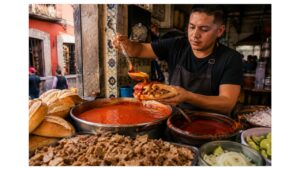
How Tortas Ahogadas Are Made: Birote, Carnitas, Tomato Sauce & Chile de Árbol
A torta ahogada doesn’t require dozens of ingredients.
What it requires is a handful of ingredients doing very specific jobs.
The bread needs to withstand the sauce. The pork needs enough richness to remain noticeable beneath it. The tomato sauce needs to soak into the sandwich without overwhelming everything else. The chile sauce needs to bring genuine heat. And the garnishes need enough acidity and freshness to keep all that pork, bread, and salsa from becoming heavy.
That’s why a great torta ahogada is less about piling ingredients onto a sandwich and more about balance, structure, and timing.
Birote Salado: The Bread That Makes the Drowning Possible
Start with the ingredient that makes the entire concept work: birote salado.
At a glance, birote can resemble other elongated Mexican breads, particularly bolillo. But Guadalajara’s traditional birote salado has a firm, crisp crust and substantial interior structure that make it particularly suited to tortas ahogadas.
That’s important because ordinary soft sandwich bread has an obvious weakness when confronted with a ladle full of tomato sauce:
It gives up.
Birote fights back.
Its crust softens as it absorbs sauce, but the bread can retain enough structure for the sandwich to remain intact rather than immediately turning into bread pudding with carnitas in it.
This isn’t simply a clever choice of bread. Birote salado is deeply associated with Guadalajara and Jalisco, making it another reason tortas ahogadas are difficult to separate from their place of origin.
Carnitas: The Rich Center
The traditional filling is pork carnitas.
That’s a particularly smart pairing because carnitas have enough richness and concentrated pork flavor to remain distinct after the sandwich is drowned.
Pieces of tender pork are packed inside the split birote before the sauces are added. Depending on the establishment, the texture and cut of the carnitas can vary, giving different tortas their own personality.
But the function remains the same.
The pork provides the savory, fatty foundation against which tomato, chile, onion, and lime can push.
The Tomato Sauce: Where the Drowning Begins
Then comes the sauce that gives the torta ahogada its unmistakable appearance.
A seasoned tomato-based sauce is poured generously over the assembled sandwich, coating the crust and beginning to soak into the bread.
This is where the name becomes literal.
Ahogada means drowned.
Not lightly dressed.
Not drizzled.
Not served with a tasteful spoonful of salsa on the side.
Drowned.
But an important misconception is worth clearing up: the red sauce covering a torta ahogada isn’t necessarily where all of its serious heat comes from.
The tomato sauce can be relatively approachable.
The real escalation happens with the chile sauce.
Chile de Árbol: Where Guadalajara Turns Up the Heat
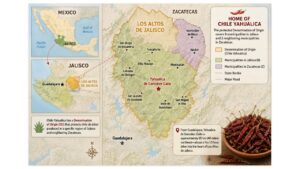
The fiery component traditionally comes from chile de árbol, and this is where the sandwich becomes even more connected to Jalisco.
In Los Altos de Jalisco, northeast of Guadalajara, the area surrounding Yahualica is famous for producing chile de árbol. Chile Yahualica has an official Mexican Denomination of Origin, protecting chiles produced within a defined region of Jalisco and neighboring Zacatecas and recognizing the characteristics associated with the region and its traditional production.
That chile has a particularly meaningful relationship with the torta ahogada. Mexican agricultural authorities specifically identify Chile Yahualica with regional foods including tortas ahogadas and birria.
So when chile de árbol sauce hits a torta ahogada, it isn’t merely there because somebody decided the sandwich needed to be hotter.
It connects Guadalajara’s signature sandwich with another celebrated food tradition from Jalisco.
And unlike the broader tomato sauce, chile de árbol salsa allows the diner—or the person preparing the torta—to control just how dangerous lunch is about to become.
A little provides a sharp chile bite.
A lot changes the entire personality of the sandwich.
🌶️ Professor Pepper Says…
Don’t assume every red sauce on a torta ahogada has the same job. The tomato sauce provides much of the drowning, moisture, and savory flavor, while chile de árbol salsa can supply the serious heat. Understanding the two separately makes the sandwich much easier to understand—and much safer to order.
Onion, Lime & the Finishing Touches
With bread, carnitas, tomato, and chile doing the heavy lifting, the finishing ingredients provide contrast.
Onion brings sharpness and texture.
Lime contributes acidity.
Depending on the establishment and preparation, additional garnishes and accompaniments may appear, but the best additions don’t distract from the sandwich. They cut through the richness and brighten a dish dominated by pork, bread, and sauce.
The result is surprisingly balanced for something that looks as though it has been attacked with a soup ladle.
You get crispness turning soft at the edges.
Tender pork against substantial bread.
Savory tomato followed by chile heat.
Richness interrupted by onion and citrus.
And beneath everything, the unmistakable structure of birote salado trying heroically to keep lunch together.
THE MAGIC OF A TORTA AHOGADA ISN’T THAT GUADALAJARA DROWNS A SANDWICH—IT’S THAT EVERY INGREDIENT WAS BUILT TO SURVIVE THE DROWNING.
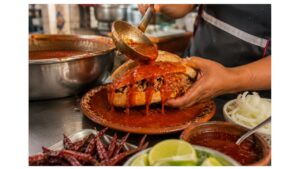
Torta Ahogada vs. a Regular Mexican Torta: What’s the Difference?
Calling a torta ahogada simply a “Mexican sandwich with sauce” misses what makes it special.
Mexico has an enormous torta tradition.
Depending on the region and establishment, tortas can contain carnitas, milanesa, ham, cheese, avocado, beans, eggs, chorizo, chicken and countless other fillings. They’re commonly built on breads such as bolillos and teleras and eaten as practical handheld meals.
A torta ahogada belongs to that larger family—but Guadalajara changes the rules.
The most obvious difference is the sauce.
A conventional torta may contain salsa, crema, mayonnaise, avocado, beans, or other moist ingredients inside the bread while remaining fundamentally handheld.
The torta ahogada moves the sauce outside.
Lots of it.
Instead of protecting the bread from moisture, the preparation deliberately exposes the entire sandwich to it.
That changes everything.
The crust absorbs tomato flavor. The exterior softens. The carnitas begin interacting with the sauce. Eating with your hands becomes considerably more ambitious, and utensils become perfectly reasonable equipment.
But the second difference is arguably even more important:
birote salado.
A softer telera makes wonderful tortas precisely because of its tender texture. A bolillo provides more crust and structure. But the traditional torta ahogada asks its bread to perform an unusually difficult job.
It needs to be drowned.
That’s why simply stuffing carnitas into any sandwich roll and pouring salsa over it produces something inspired by a torta ahogada, but not necessarily the Guadalajara experience that made the dish famous.
The third difference is regional identity.
“Torta” describes an enormous category of Mexican sandwiches.
“Torta ahogada” immediately points toward Guadalajara and Jalisco.
The distinction is similar to other regional Mexican foods we’ve been exploring. A dish becomes more interesting when we stop treating “Mexican food” as one giant cuisine and start asking where in Mexico a particular tradition belongs.
For a broader look at the sandwich family surrounding the torta ahogada, Tortas Loaded with Meat, Melted Cheese & Street Food Flavor That Hits Hard gives readers the larger context for how Mexican tortas are built, filled, and eaten.
The torta ahogada is one branch of that family.
It’s just the branch that jumped into the swimming pool.
A REGULAR TORTA USES BREAD TO HOLD ITS FILLINGS; A TORTA AHOGADA MAKES THE BREAD, SAUCE, AND FILLING PART OF THE SAME EXPERIENCE.
Why Birote Salado Matters So Much to an Authentic Torta Ahogada
If there’s one ingredient Americans trying to reproduce tortas ahogadas are most likely to underestimate, it’s the bread.
You can make excellent carnitas.
You can blend a beautiful tomato sauce.
You can find chile de árbol.
You can slice onions and squeeze limes.
But if the bread dissolves the moment the sauce hits it, you’ve learned exactly why Guadalajara relies on birote.
Birote salado isn’t merely a vessel.
It determines the texture of the dish.
The first bite of a well-prepared torta ahogada can contain several states of bread simultaneously. The outer surface has absorbed sauce. Areas immediately beneath it begin to soften. Deeper sections retain chew and structure. The crust still provides resistance.
That progression is part of the pleasure.
It’s also why timing matters.
A torta ahogada isn’t designed to sit around indefinitely after drowning. The changing texture begins as soon as the sauce hits the bread, meaning the sandwich is best understood as something assembled, sauced, and eaten as part of one continuous experience.
This helps explain why eating one in Guadalajara is so different from encountering a packaged approximation somewhere else.
The food stand isn’t merely selling ingredients.
It’s controlling the sequence.
- Bread is split.
- Carnitas go in.
- Sauce goes over.
- Chile is adjusted.
- Garnishes arrive.
- You eat.
That’s street-food construction in its purest form.
🌶️ Professor Pepper Says…
Birote salado shows why regional ingredients matter. Replace it with very soft sandwich bread and you haven’t merely changed the flavor—you’ve changed the engineering of the dish. Authentic food traditions often make more sense when you ask what each ingredient is designed to do.
WITHOUT BIROTE SALADO, YOU CAN RECREATE THE FLAVORS OF A TORTA AHOGADA—BUT RECREATING ITS TEXTURE IS MUCH HARDER.
How Guadalajara Eats Tortas Ahogadas
Understanding a torta ahogada on paper is useful.
Understanding one while sitting in Guadalajara with red sauce creeping toward the edge of your plate is considerably better.
The dish is part of everyday Tapatío food culture rather than something reserved exclusively for formal restaurants or special occasions. Tortas ahogadas are sold across Guadalajara at dedicated shops, neighborhood counters, markets, and casual establishments, with individual vendors earning loyal followings for their particular combination of bread, carnitas, tomato sauce, and chile. Jalisco tourism treats the dish as one of Guadalajara’s defining gastronomic experiences.
And ordering one introduces an important decision:
How drowned do you want it?
Depending on the establishment, diners may encounter different approaches to the amount of sauce and chile. Someone testing the waters can begin more cautiously, while experienced chile eaters can move toward considerably hotter territory.
That’s part of the fun.
The torta ahogada isn’t merely standardized assembly. Different shops develop reputations around their sauces, carnitas, bread, heat, and technique. Locals have preferences. Families have favorites. Arguments can develop over which establishment does it best.
That is usually a good sign.
Foods become culturally important when people stop merely consuming them and start developing opinions about how they should taste.
And Guadalajara has plenty of opinions about tortas ahogadas.
The experience also reinforces something that has appeared repeatedly throughout our exploration of Mexican street food:
Place changes flavor.
You can reproduce ingredients elsewhere. You can study recipes. You can learn techniques.
But eating a regional specialty where generations of people have established expectations around it provides context no ingredient list can completely reproduce.
That’s true of birria in Jalisco.
It’s true of carne en su jugo in Guadalajara.
And it’s absolutely true of a torta ahogada disappearing beneath a ladle of red sauce at a neighborhood counter.
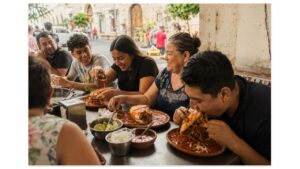
🌎 If You Ever Visit Mexico…
If you find yourself in Guadalajara, don’t treat a torta ahogada as something to squeeze in after you’ve tried everything else. Visit a busy neighborhood torta shop, watch how the bread is filled and drowned, and ask about the different sauces before automatically requesting maximum heat. Notice the texture of the birote, taste the tomato sauce before adding more chile, and pay attention to how locals order theirs. Then accept that eating neatly was never really part of the assignment.
TO UNDERSTAND GUADALAJARA THROUGH FOOD, FOLLOW THE BIROTE, CARNITAS, TOMATO, AND CHILE UNTIL THEY ALL DISAPPEAR BENEATH THE SAUCE.
🍽️ Make Authentic Tortas Ahogadas at Home
Eating a torta ahogada at a neighborhood stand in Guadalajara is difficult to reproduce completely at home.
Fortunately, making an extremely good drowned sandwich is considerably easier.
The goal isn’t simply to make carnitas, stuff them into bread, and dump salsa over the top. A successful homemade torta ahogada depends on recreating the same balance we’ve been exploring throughout this guide: sturdy bread, rich pork, savory tomato sauce, fiery chile de árbol, sharp onion, fresh lime, and enough sauce to earn the word ahogada.
Start with the bread.
Authentic birote salado is the ideal choice because its sturdy crust and substantial structure are designed for exactly this kind of treatment. If authentic birote isn’t available where you live, choose the crustiest, densest Mexican-style roll you can find rather than a soft sandwich bun.
Fill the bread generously with warm pork carnitas.
For the drowning sauce, prepare a smooth tomato-based salsa seasoned with garlic, onion, and appropriate spices. The exact recipe varies, but the goal is a flavorful, relatively fluid sauce capable of penetrating the bread rather than sitting on top like a thick condiment.
Then prepare the heat separately.
A chile de árbol salsa lets you control the fire independently from the tomato sauce. That’s especially useful when serving several people because one diner can keep things relatively civilized while another can discover whether their confidence was justified.
Place the filled sandwich on a plate.
Ladle the tomato sauce generously over the bread.
Add chile sauce according to tolerance.
Finish with onion and lime.
And eat it immediately.
That last instruction matters.
Once the sauce hits the birote, the sandwich begins changing. The crust absorbs liquid, the interior softens, carnitas mingle with tomato and chile, and the torta moves toward the texture Guadalajara intended.
Don’t wait twenty minutes trying to get the perfect photograph.
Drown it. Eat it. Accept the napkin situation.
THE BEST HOMEMADE TORTA AHOGADA ISN’T THE NEATEST ONE—IT’S THE ONE WHERE THE BREAD, CARNITAS, TOMATO, CHILE, ONION, AND LIME ALL ARRIVE IN THE SAME BITE.
🌶️ Recommended Peppers of Key West Products for Tortas Ahogadas
Tortas ahogadas already have a strong chile identity, so the goal isn’t to bury Guadalajara’s traditional flavors beneath bottled hot sauce. The best Peppers of Key West pairings either complement the carnitas and tomato sauce, offer an accessible alternative when chile de árbol salsa isn’t available, or give you another way to explore the sandwich’s combination of pork, acidity, and heat.
Product Pairing Quick Guide
- Classic carnitas torta ahogada → Serrano Pepper Hot Sauce
- Extra-garlicky tomato sauce and pork → Jalapeño Garlic Hot Sauce
- Torta ahogada for serious heat lovers → Habanero Pepper Hot Sauce
- Build-your-own Mexican sandwich night → Peppers of Key West Ultimate Hot Sauce 5-Pack
🌶️ Best Peppers of Key West Pairings for Torta Ahogada Lovers
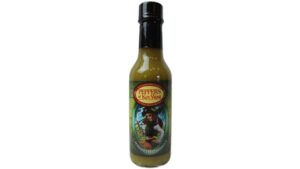
Peppers of Key West Serrano Pepper Hot Sauce
Serrano Pepper Hot Sauce is a natural match for tortas ahogadas, bringing bright green-chile flavor that complements rich pork carnitas, tomato, onion, and lime without trying to replace traditional chile de árbol salsa. It adds another layer of pepper flavor while allowing the distinctly Guadalajara character of the torta to remain the star.
Perfect For: Tortas ahogadas, carnitas, tacos, quesadillas, grilled pork, eggs, salsa
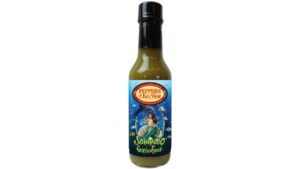
Peppers of Key West Jalapeño Garlic Hot Sauce
Jalapeño Garlic Hot Sauce works especially well when you want additional flavor without dramatically escalating the heat. Jalapeño brings familiar green-chile character while garlic fits comfortably alongside the tomato, pork, and savory components already present in a torta ahogada.
Perfect For: Tortas, carnitas, burritos, tacos, eggs, roasted vegetables, sandwiches
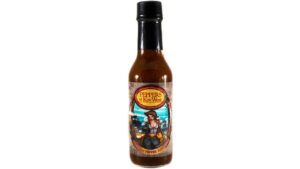
Peppers of Key West Habanero Pepper Hot Sauce
Habanero Pepper Hot Sauce takes the heat considerably higher while adding the fruity chile character that makes habanero so distinctive. That combination works particularly well against rich pork carnitas and acidic tomato sauce, making it a natural choice for chile lovers who want their torta ahogada experience substantially hotter.
Perfect For: Tortas ahogadas, carnitas, tacos, pork, grilled meats, salsa, adventurous chile lovers
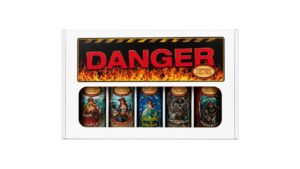
Peppers of Key West Ultimate Hot Sauce 5-Pack
A torta ahogada night is an ideal excuse to let everyone control their own heat. The Peppers of Key West 5-Pack brings together Cayenne, Jalapeño, Habanero, Ghost, and Carolina Reaper Hot Sauces, turning the table into a progression from approachable chile heat to decisions that may require reconsideration.
Perfect For: Mexican food nights, tortas, tacos, carnitas, quesadillas, chile tasting, gifts
Why Tortas Ahogadas Are One of Guadalajara’s Great Food Traditions
It’s easy to remember the torta ahogada because of the spectacle.
A sandwich gets drowned in red sauce.
You need a plate.
You probably need utensils.
You definitely need napkins.
And if you underestimate the chile sauce, you may need a brief period of personal reflection.
But concentrating only on the mess misses why this dish matters.
The torta ahogada is a remarkably compact expression of Guadalajara and Jalisco.
Birote salado gives the sandwich its structure and ties it directly to Guadalajara’s bread tradition.
Carnitas provide the rich pork center.
Tomatoes become the sauce responsible for the drowning.
Chile de árbol supplies the fire, with celebrated Chile Yahualica connecting the sandwich to Los Altos de Jalisco.
Onion and lime bring the brightness necessary to hold everything together.
And generations of Tapatíos turned those ingredients into something recognizable enough to become one of Guadalajara’s culinary signatures.
That’s the larger lesson hiding beneath all that sauce.
Regional foods become important because ingredients, geography, technique, and people intersect in ways that are difficult to reproduce anywhere else.
That’s why understanding Mexican street food requires moving beyond the idea of a single national menu.
Mexico City gives us its own street-food traditions.
Puebla gives us chalupas and cemitas.
Oaxaca gives us tlayudas and memelas.
The Yucatán gives us cochinita pibil.
Jalisco gives us birria.
And Guadalajara gives us a sandwich that somebody had the magnificent audacity to drown.
Once you understand the bread, pork, tomato, chile, geography, and people behind it, the torta ahogada stops looking like a novelty.
It starts looking like what it really is:
A regional food tradition.
THE TORTA AHOGADA MAY BE FAMOUS FOR BEING DROWNED IN SAUCE, BUT WHAT MAKES IT UNFORGETTABLE IS HOW MUCH OF GUADALAJARA SURVIVES IN EVERY BITE.
Frequently Asked Questions:
What is a torta ahogada?
A torta ahogada is Guadalajara’s famous “drowned sandwich,” traditionally made with birote salado filled with pork carnitas and generously covered with tomato sauce and spicy chile sauce.
Where did tortas ahogadas originate?
Tortas ahogadas originated in Guadalajara, Jalisco, where they developed into one of the city’s most recognizable regional foods and remain closely connected to local culinary identity.
Why is it called a torta ahogada?
Ahogada means “drowned.” The name refers to the preparation method in which the filled sandwich is generously covered or submerged in sauce before being served.
What bread is used for tortas ahogadas?
Traditional tortas ahogadas use birote salado, a crusty Guadalajara bread whose firm exterior and substantial structure allow it to absorb sauce without immediately falling apart.
What meat is traditionally used in tortas ahogadas?
Pork carnitas are the classic filling. Their richness and concentrated pork flavor stand up particularly well to the tomato sauce, chile heat, onion, lime, and substantial bread.
What chile is used in tortas ahogadas?
Chile de árbol is traditionally associated with the spicy salsa served with tortas ahogadas. Jalisco’s celebrated Chile Yahualica gives the chile component an especially strong regional connection.
How spicy are tortas ahogadas?
They can range from moderately spicy to extremely hot. Tomato sauce provides much of the drowning, while the amount of chile de árbol salsa can substantially increase the heat.
What’s the difference between a torta and a torta ahogada?
Torta is a broad category of Mexican sandwiches. A torta ahogada is a distinctly Guadalajara preparation traditionally built on birote salado and deliberately drowned in sauce.
Can I make tortas ahogadas without birote salado?
Yes, although the texture will differ. If authentic birote isn’t available, choose a sturdy, crusty roll capable of absorbing plenty of sauce without immediately collapsing.
What do you serve with tortas ahogadas?
Onion, lime, and additional chile salsa are natural accompaniments. Depending on the establishment and regional preference, tortas ahogadas may also be served with other simple garnishes or sides.
🌮 Continue Your Adventure
Taste More of Jalisco & Mexico’s Legendary Street Food
- Birria Explained: Jalisco’s Legendary Slow-Cooked Stew Before It Became a Taco Sensation
- Carne en su Jugo Explained: Guadalajara’s Beef Dish That Comfort Food Lovers Need to Try
- Cemitas Explained: Mexico’s Ultimate Street Food Sandwich Loaded with Flavor
- Tacos Árabes Explained: The Puebla Street Food That Inspired Al Pastor
- Pambazos Explained: Mexico’s Salsa-Soaked Sandwich That Eats Like a Full Meal
- Chalupas Explained: Puebla’s Traditional Street Food That’s Nothing Like Taco Bell
- Garnachas Explained: Mexico’s Crispy Street Food That Changes from Region to Region
- Cochinita Pibil Explained: The Legendary Yucatán Pork Dish Americans Are Missing
🌎 Expand Your Flavor Journey
- The Complete Mexican Street Food Guide: Ingredients, Dishes, Regions & Cooking Terms Explained
- How to Build the Ultimate Taco Night Spread
- Mexican Street Food Sauces Beyond Salsa: Crema, Chili Oils, Citrus Heat & More
- Mexican Tortillas, Masa & Breads Explained: The Complete Guide to How Mexican Street Food Is Built
Explore More Tortas Ahogadas Keywords
torta ahogada, tortas ahogadas, torta ahogada recipe, Guadalajara torta ahogada, Guadalajara drowned sandwich, Mexican drowned sandwich, Jalisco torta ahogada, Guadalajara street food, Jalisco street food, traditional Guadalajara food, traditional Jalisco food, Mexican sandwich, Mexican torta, Mexican street food sandwich, birote salado, birote Guadalajara, birote bread, carnitas torta, pork carnitas sandwich, chile de árbol, chile de árbol salsa, Chile Yahualica, Yahualica chile, Los Altos de Jalisco chile, torta ahogada sauce, torta ahogada salsa, tomato sauce torta ahogada, spicy torta ahogada, authentic torta ahogada, how to make torta ahogada, what is torta ahogada, what does torta ahogada mean, torta ahogada ingredients, bread for torta ahogada, Guadalajara food, foods from Guadalajara, famous Guadalajara foods, foods from Jalisco, Jalisco cuisine, Tapatío food, Guadalajara culinary traditions, Mexican regional food, Mexican sandwich bread, carnitas Guadalajara, Mexican chile sauce, traditional Mexican sandwiches, best Mexican street food, tortas in Mexico, drowned carnitas sandwich, authentic Mexican street food
