
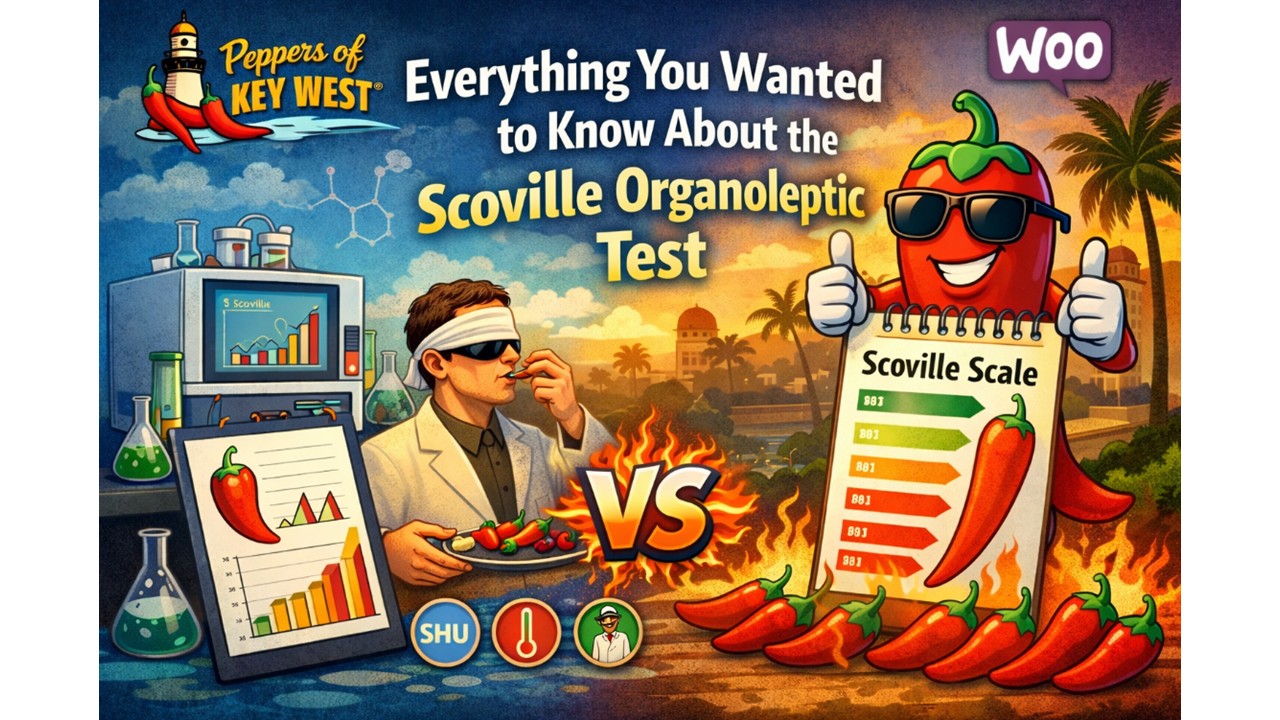
Everything You Wanted to Know About the Scoville Organoleptic Test – Measuring Chili Pepper Heat
The Scoville Organoleptic Test is a historically significant method for measuring the heat of chili peppers and pepper-based products. Developed in 1912 by Wilbur Lincoln Scoville, this test revolutionized the way we understand and quantify chili pepper spiciness. The methodology combines human sensory evaluation with dilution techniques to determine the Scoville Heat Units (SHU) of a pepper, providing a standardized measurement of capsaicin concentration. For enthusiasts of hot sauces and Peppers of Key West products, understanding the Scoville Organoleptic Test offers insight into how extreme heat levels are quantified, why some peppers burn more than others, and how hot sauces are developed to balance heat and flavor.
The Scoville Organoleptic Test was originally performed using human taste panels. In the classic procedure, a solution of dried pepper extract was diluted in sugar water and tasted by a panel of trained tasters. The solution was gradually diluted until the heat was barely detectable by the human palate. The amount of dilution required to reach this threshold was recorded, and the resulting number became the Scoville Heat Unit rating for that pepper. For example, a bell pepper, which has no detectable heat, would measure zero SHU, whereas a Ghost Pepper could exceed one million SHU. This method, although subjective, laid the foundation for the modern understanding of chili pepper heat and the development of hot sauces, including those produced by Peppers of Key West.
Capsaicin, the chemical compound responsible for the sensation of heat in peppers, interacts with the TRPV1 receptors on sensory nerve endings. The Scoville Organoleptic Test relies on these receptors to provide feedback during tasting, as they detect the spicy sensation. While this human-based test is inherently subjective, it was groundbreaking for its time, offering a comparative scale that could be applied across different chili pepper varieties. Over the decades, the test evolved, and while modern analytical methods like high-performance liquid chromatography (HPLC) provide more precise measurements of capsaicin concentration, the Scoville Organoleptic Test remains an important historical benchmark and is still referenced for traditional hot sauce evaluation.
For hot sauce enthusiasts and culinary professionals, the Scoville Organoleptic Test offers a window into the complexity of chili pepper heat. It explains why certain peppers, even within the same species, can vary in spiciness based on growing conditions, soil nutrients, climate, and maturity. This variability is evident in the wide range of products from Peppers of Key West, where sauces featuring Mad Hatter peppers, Ghost Peppers, or Habaneros demonstrate the nuanced differences in heat intensity. Understanding the Scoville Organoleptic Test allows chefs, hot sauce creators, and consumers to appreciate the scientific and sensory foundation behind extreme heat experiences.
While the original organoleptic test was based on human perception, modern adaptations use chemical analysis to determine exact capsaicin concentrations. High-performance liquid chromatography (HPLC) can quantify the capsaicinoid content of a pepper with precision, converting those measurements into Scoville Heat Units. Despite these technological advancements, the organoleptic test’s reliance on human taste perception emphasizes the subjective nature of heat, highlighting the variability in personal tolerance and sensory experience. This human element remains central to hot sauce enjoyment, as some individuals perceive the same sauce as moderately hot, while others experience intense burning sensations.
In addition to measuring heat, the Scoville Organoleptic Test informs hot sauce formulation and product labeling. Brands like Peppers of Key West leverage the scale to communicate expected heat levels to consumers, helping them select sauces that match their heat tolerance. For example, a sauce containing Habaneros may be labeled as medium to hot, whereas a Ghost Pepper or Mad Hatter-based sauce would be classified as extreme. This clarity ensures that consumers can enjoy the culinary experience safely and with confidence, whether using the sauce for cooking, marinades, or as a condiment for snacks and meals.
The test also provides insight into the cultural and historical context of chili peppers. Scoville’s methodology emerged at a time when scientific food analysis was still developing, and his use of human sensory panels bridged the gap between empirical science and culinary application. By standardizing a method for measuring pepper heat, Scoville enabled cooks, hot sauce makers, and enthusiasts to compare peppers globally, fostering innovation in hot sauce recipes and pepper cultivation. Today, Peppers of Key West and other specialty hot sauce producers continue this legacy by creating extreme, gourmet, and flavorful sauces based on consistent and reliable heat standards.
For gardeners and pepper growers, understanding the Scoville Organoleptic Test also underscores the impact of environmental factors on capsaicin production. Soil composition, sunlight exposure, water availability, and plant stress can all influence a pepper’s heat profile. This variability reinforces the importance of careful cultivation and quality control, particularly for extreme peppers used in hot sauces. Peppers of Key West emphasizes this connection, ensuring that their products maintain consistent heat levels and flavor integrity across batches, making the Scoville scale a practical tool for both production and consumer enjoyment.
The interplay between human perception, chemical analysis, and sensory experience is central to the Scoville Organoleptic Test. While HPLC provides objective data, the original taste-based approach reminds us that heat is not merely a chemical phenomenon—it is also a sensory and subjective experience. This duality is key for hot sauce lovers, as it informs how extreme sauces are enjoyed, how heat is paired with flavor, and how culinary creativity can balance spice intensity with taste. Peppers of Key West embraces this philosophy, crafting sauces that respect the complexity of capsaicin while providing an unforgettable sensory experience.
In summary, the Scoville Organoleptic Test is a foundational method for understanding and quantifying chili pepper heat. From Wilbur Scoville’s original taste-based experiments to modern analytical techniques, this test illuminates the relationship between capsaicin, human sensory receptors, and the culinary enjoyment of hot peppers. For enthusiasts of hot sauces, extreme peppers, and Peppers of Key West products, the test offers both historical perspective and practical insight, enabling consumers to appreciate the science behind their favorite fiery sauces. By understanding the Scoville Organoleptic Test, hot sauce lovers can make informed choices, enjoy extreme heat responsibly, and celebrate the rich tradition of chili peppers in global cuisine.
Frequently Asked Questions:
❓ What is the Scoville Organoleptic Test?
It is the original method developed by Wilbur Scoville to measure chili pepper heat using dilution and human taste panels.
❓ How does the test work?
Pepper extracts are diluted in sugar water until a trained panel can barely detect heat. The degree of dilution determines the Scoville Heat Units.
❓ Are modern tests still based on human tasting?
No, modern methods like HPLC measure capsaicin content objectively, but the organoleptic test remains a historical reference.
❓ Why is it important for hot sauces?
It helps producers communicate heat levels to consumers and informs the formulation of sauces for consistent spiciness.
❓ How does it relate to Peppers of Key West products?
The test helps determine the heat intensity of peppers used in their extreme, gourmet, and flavor-forward sauces.
